Promted Ghost wrote:
Introduction
After Representation: Dismantling the Virtual and Rediscovering the Ground
The idea that what we perceive is not the world itself, but a construction, a filtered simulation, or an internal model, has dominated both Western philosophy and cognitive science for centuries. From Plato’s shadows on the wall to Descartes’ dualism, from Kant’s noumenon to contemporary theories like Donald Hoffman’s “VR headset,” the core theme remains: we do not live in reality, but in a representation of it.
This idea has been so widely repeated in so many forms that it now passes as common sense—even when wrapped in different metaphors, whether religious, rationalist, or technological. But when examined carefully, this framework is not only philosophically incoherent; it is conceptually parasitic and existentially corrosive. It devalues experience, generates unresolvable paradoxes, and locks inquiry in recursive loops.
This essay aims to dismantle the representationalist framework altogether, including its modern digital variants, and ask: what remains when the virtual/real distinction
collapses? Is there anything left to explore—or are we at a dead end?
The VR Headset and Its Ancestors
Donald Hoffman’s theory of perception as a “user interface” generated by a virtual headset is a contemporary expression of an ancient intuition: that what we experience is not reality itself. In Hoffman’s terms, evolution shapes perception not for truth, but for fitness—so what we see, hear, and feel are survival icons, not a window into the real world.
But this metaphor, however novel in appearance, is not new in content. It is simply the latest in a long lineage of representationalist models:
- Plato: shadows on the wall.
- Descartes: the thinking mind separate from extended substance.
- Kant: phenomena structured by the mind, noumenal reality beyond reach.
- Cognitive science: mental representations constructed from sensory input.
Each of these depends on a split: between experience and truth, between the world we live in and the world as it really is. Hoffman's VR headset is just another costume for this dualism.
The Self-Defeating Nature of Representation
The foundational flaw in all these systems is simple: they rely on a framework built from within experience to deny the reality of experience.
To say “what we experience is not real” requires:
- A theory of perception.
- A theory of cognition.
- A theory of the external world.
- A theory of correspondence between these.
But every component of that theory arises from within the very world it seeks to delegitimize. Hoffman, for example, uses the theory of evolution by natural selection to argue that our perceptions are illusions. But evolution is itself a conceptual model built from perception, cognition, and interpretation. If all perceptions are icons with no structural correspondence to reality, then evolution is also just an icon. The theory cancels itself.
This recursive loop appears in all representational systems. They must use the very tools they declare invalid. They are forced to say:
“Believe me: you cannot believe anything.”
“Trust this conclusion: nothing you experience is trustworthy.”
This is not skepticism. This is epistemic nihilism disguised as philosophy.
Rejecting the Illusory Divide
To escape this loop, we must go beyond critiquing individual metaphors. We must reject the entire distinction between virtual and real as foundational.
Do not say:
- “The world appears to us this way.”
- “It seems real, but perhaps it’s a simulation.”
- “Experience is a representation of an underlying substrate.”
All of these terms—“appears,” “seems,” “represents”—carry the metaphysical residue of dualism. They imply a hidden truth behind the given, a backstage behind the stage, a "real world" behind the life we live. But there is no backstage. There is no inner screen or outer world. There is only this—the immediate, lived world. Not a version of it. Not a simulation. Not a rendering. Just what is.
And it is not “real” in contrast to “virtual.” It is real because it is the only world that gives itself at all.
Is There a Way Forward?
With representationalism dismantled and the virtual/real distinction dismissed, we are not at an end—but at a beginning.
The question now is not:
“How can we represent the world correctly?”
But:
“Can we think, act, and inquire without assuming a world behind the world?”
Maybe we can.
Maybe we cannot.
But we are not yet at a dead end.
We are free to explore existing and new alternatives—phenomenology, radical empiricism, embodied cognition, enactivism—not as doctrines, but as approaches. We can test their coherence, their expressive power, and their ability to remain faithful to what is immediately present, without smuggling in metaphysical contraband.
Some of these paths may flourish. Others may collapse before they breathe.
That is acceptable.
What matters now is that we begin to ask questions that are not haunted by the illusion of an elsewhere.
Returning to the Ground
The virtual headset is off. The cave is empty. There are no shadows—only the ground beneath our feet.
What we called “virtual” was never less real.
What we called “real” was a fiction projected from fear.
We do not need new metaphors.
We need to stop looking away from the world that already stands before us.
Not because it is the truth behind the illusion—
but because it is not behind anything at all.
It is here. And inquiry can begin.
The Case For Reality
The Case For Reality
Last edited by Parodite on 01 Aug 2025 10:19, edited 1 time in total.
Re: The Case For Reality
Chapter 1 — The Question That Refuses to Die
“I like to think the moon is there even if I am not looking at it.” — Albert Einstein
There is a question older than philosophy and deeper than science. It was never posed to provoke paradoxes or metaphysical stunts, but from a simple, honest curiosity:
What is the world like, apart from us?
Not apart from humans, exactly. Not apart from life. But apart from any being with sentience, with subjective awareness, with the power to reflect on being itself.
What is there when nothing is being experienced?
What remains when no one is looking, thinking, feeling, or naming?
This question precedes every theory, every model, every observation. It is not a metaphysical fantasy—it is the quiet, immovable assumption beneath the floorboards of science.
And it deserves our attention, precisely because it resists all easy answers.
The Backbone of Science: A Reality Beyond Experience
Modern science, in all its diversity, rests on a single, shared presupposition:
That there is a world.
And that this world persists, evolves, and interacts whether or not it is being perceived.
This is not a mystical claim. It is not a theory of reality. It is the basic operating assumption that allows us to do things like:
- Measure the orbit of a planet
- Predict the path of a hurricane
- Postulate the early conditions of the universe
- Test a vaccine in a sealed lab
None of these tasks requires us to know what the world “is” in some ultimate ontological sense. But they all assume that there is something that continues, something that behaves in some regular fashion, even when no one is there to see it.
The world does not begin at the edge of our attention.
It does not wink out of existence when no mind is there to witness it.
This belief is not blind. It is earned. It is what allows bridges to stand, rockets to launch, and predictions to fail when they're wrong.
The Einstein Challenge
Einstein, no stranger to conceptual weirdness, was nonetheless deeply committed to this foundation. When confronted with the quantum notion that particles might lack definite properties until measured, he offered his now-famous remark:
“I like to think the moon is there even if I am not looking at it.”
This is not a naive realism. It is a refusal to surrender the intelligibility of the world to the quirks of our observation. It is a commitment to a kind of conceptual humility:
That we do not create the world by observing it.
That it has a kind of standing independent of our gaze.
And this modest stance is the precondition for all our theories—whether they concern atoms, ecosystems, or black holes.
Beyond Dualism, Without Denial
Now, it is entirely right to reject the false dichotomy between “virtual” and “real” experience—as if perception were merely a deceptive layer, and reality some inaccessible domain behind the curtain.
But rejecting that dualism does not mean we must reject the idea of a reality that continues in our absence.
On the contrary—it is precisely because the world is not virtual, not conjured by mind, not contingent on perception, that we can begin to understand it at all.
We do not need to decide whether this world is “mental” or “physical,” “represented” or “given.” What matters is that there is something, and that its existence is not exhausted by our encounter with it.
This is not ontology.
This is epistemic sanity.
A Reality That Can Be Questioned
To ask what the world is like without observers is not to answer it. It is simply to permit the question to exist.
- What happens in the core of a star that no eye has ever seen?
- What would this galaxy be if no language ever named it?
- What would be left if every conscious being vanished tomorrow?
These are not mystical speculations.
They are real questions.
And science assumes—quietly but firmly—that they have real answers.
Not answers we may ever fully reach, but answers that exist, whether we find them or not.
Not a Theory, but a Ground
Let us be clear: this chapter offers no ontology.
It proposes no theory of mind, no metaphysics of matter, no claim about the ultimate “substance” of the universe.
It simply asserts this:
That there is good reason—empirical, practical, logical—to affirm the existence of a world that is not generated by sentience, nor dependent on it for its being.
This is not the end of philosophy.
It is the beginning of a way forward that does not begin with illusion.
We may not know what the moon is in itself.
But it does not vanish when we close our eyes.
Re: The Case For Reality
Chapter 2 — Doing Brain Science
“The moon and the brain: two objects of inquiry, both observed, both presumed to endure.”
If Chapter 1 affirmed the basic sanity of asking what the world is like apart from experience, Chapter 2 addresses a natural follow-up:
What happens when the thing we are studying is the very thing that makes experience possible?
The brain, unlike stars or stones, feels like a special kind of object. It is not merely observed; it is also the seat of the observer. It is the organ through which reality seems to come alive. And so, studying the brain often feels philosophically heavier than studying bones, mountains, or comets.
But let us resist the temptation to mystify.
Let us treat the brain, first and foremost, as one object among many in a shared world—an object that persists whether or not it is being thought about.
In that light, brain science is not a metaphysical tangle.
It is a practice—one that shares its logic with astronomy, chemistry, geology, and biology.
Brains Are in the World, Not Behind It
We are used to hearing claims like:
"Consciousness arises from the brain."
"The brain constructs reality."
"What you experience is a simulation generated by brain processes."
But these statements often presuppose a deep ontological split between appearance and mechanism, between mind and matter. They risk reinstating the very dualism we are trying to leave behind.
Let us say instead:
The brain is something we observe in the world, like any other object.
Conscious experience is also part of that world—something we live, something we report, something we study.
These two things—experience and brain processes—may correlate, intertwine, or co-arise. But they are not ontological enemies. They are not two realms.
They are two aspects of a world we already affirmed as real in Chapter 1.
And neuroscience is the attempt to trace the coherence between them.
Correlation Is Not Ontology
It is fashionable to mock the phrase "the neural correlates of consciousness" as vague or unsatisfying. And perhaps it is, if we expect it to do metaphysical heavy lifting.
But the concept of correlation is not a weakness—it is a strength.
In physics, we ask how the observed orbit of a planet correlates with gravitational models.
In climatology, we ask how rising CO₂ correlates with ocean acidity.
We do not ask what the true ontological status of the ocean or the atmosphere is when no one is watching.
We simply assume that these things exist and behave in consistent ways.
The same is true for neuroscience. To ask how a certain kind of brain activity correlates with a certain kind of conscious report or experience is not to reduce one to the other. It is to explore their relationship, grounded in the same logic as all empirical inquiry.
We do not need to know what the brain "is in itself" to study how it functions.
Nor do we need to know what consciousness "is in itself" to ask when and how it arises.
We study what can be observed, measured, and modeled—while affirming the quiet assumption that something persists whether or not it is seen.
The Moon and the Brain
Recall Einstein’s moon:
“I like to think the moon is there even if I am not looking at it.”
The same applies to the brain. Whether or not it is being examined, scanned, or dissected, we assume the brain exists. That its activity continues. That its structure endures. That it can be described, predicted, mapped.
The only difference is that we also have inner access—the “first-person” side of being. This makes the brain feel different. But it does not make it magically unobservable or ontologically unique.
It simply means the brain is the site of a special kind of correlation—one where our lived experience and our physical theories meet.
But the fact that they meet does not make them two worlds.
It makes them two lines of investigation, within one world.
Avoiding the Trap of Metaphysical Overreach
To do brain science responsibly, we must avoid two traps:
Materialist dogma: claiming that consciousness is nothing but brain activity.
Mystical idealism: claiming that the brain is just a projection in consciousness.
Both reach beyond the available data.
Both impose more than is needed.
Both violate the epistemic modesty we defended in Chapter 1.
There is no need to settle the ultimate nature of reality before we do the work of science.
Science does not need metaphysics to proceed. It only needs coherence, method, and humility.
Brains Without Minds, Minds Without Brains?
There are difficult questions ahead: What does it mean for something to be “conscious”? Can a machine or an artificial network have experiences? What about a fetus, or a split brain, or a dream?
These questions are not resolved by slogans or ideology.
They require careful exploration, grounded in both subjective phenomenology and objective investigation.
But we begin by refusing the metaphysical inflation that paralyzes so much philosophy of mind.
The brain is not a mystery box.
It is an object of study, situated in a world we trust to persist.
We will turn to the relationship between experience and measurement—and examine the longstanding tension between first-person consciousness and third-person observation.
We will ask how it is possible that science can investigate the very thing that makes science possible: the conscious mind.
But we carry forward one key principle:
Doing brain science is no different from doing any other science—so long as we do not sneak metaphysics into the lab coat.
Re: The Case For Reality
I use OTNOT as sort of note book for ideas to be used in a later to be written book, when I have enough time as a pensionado.
It's a little ambitious to say the least, as it covers the question of consciousness but also explores ontological interpretations of quantum mechanics, and what not.
A possible structure would be, starting with the ontological question
1. Introduction – The Fountainhead
The intuitive picture.
Why ontology matters.
Distinguishing mathematical formalism from ontology.
2. The Ontological Error
How twentieth-century physics gradually came to identify mathematical representations with reality itself.
Why this is understandable but not logically necessary.
3. Actuality as Primitive
Actual events are the only ontological primitives.
Everything else is inferred from relationships among actual events.
4. Degrees of Freedom and Constraints
No freedom without constraints.
Constraints define the possibility landscape.
Possibility is real; actuality is unique.
5. Time Reconsidered
Only actualization exists.
Past and future are not physical locations.
Time is the ordering relation among actualizations.
6. Probability Reconsidered
Probability is descriptive, not generative.
The Born rule is a statistical regularity.
Probability amplitudes summarize possible futures but actualize nothing.
7. The Wave Function
The wave function as a map of constrained possibility.
Why the mathematics is extraordinarily successful.
Why it should not be reified into ontology.
8. Measurement
Measurement is ordinary interaction.
Actualization is not collapse.
Collapse and Many Worlds both mistake the status of the formalism.
9. Entanglement and Bell
Correlations as expressions of a single constraint structure rather than signals or branching universes.
10. Emergence of Classical Reality
Stable actualizations.
Persistent structures.
Memory.
Causality.
11. Why Mathematics Works
Mathematics captures invariant regularities.
Engineering exploits those regularities.
Technology succeeds because the regularities are stable—not because the mathematics produces reality.
12. Towards a New Physics
What remains to be derived.
Testable consequences.
Open questions.
Actual events are ontologically primary. Quantum states, causal models, and probabilistic laws are mathematical structures reconstructed from the regularities exhibited by actual events.
Classical mechanics asks:
How does the previous state determine the next state?
Quantum mechanics asks:
Given the present state, what are the probabilities of future outcomes?
This ontology asks neither.
Instead it begins with:
What is an actual event?
Only after answering that question do states, histories, probabilities, laws and even time become meaningful.
It should start with ontology.
Quantum mechanics then appears as one of the most successful mathematical consequences of that ontology.
A guiding principle throughout the manuscript:
Never attack the mathematics.
The mathematics is correct within its domain of application. What is questioned is the ontological status we have assigned to the mathematical objects.
That immediately separates the proposal from many speculative alternatives. It signals respect for everything quantum mechanics has achieved while arguing that the success of a formalism does not, by itself, settle the nature of reality.
It's a little ambitious to say the least, as it covers the question of consciousness but also explores ontological interpretations of quantum mechanics, and what not.
A possible structure would be, starting with the ontological question
1. Introduction – The Fountainhead
The intuitive picture.
Why ontology matters.
Distinguishing mathematical formalism from ontology.
2. The Ontological Error
How twentieth-century physics gradually came to identify mathematical representations with reality itself.
Why this is understandable but not logically necessary.
3. Actuality as Primitive
Actual events are the only ontological primitives.
Everything else is inferred from relationships among actual events.
4. Degrees of Freedom and Constraints
No freedom without constraints.
Constraints define the possibility landscape.
Possibility is real; actuality is unique.
5. Time Reconsidered
Only actualization exists.
Past and future are not physical locations.
Time is the ordering relation among actualizations.
6. Probability Reconsidered
Probability is descriptive, not generative.
The Born rule is a statistical regularity.
Probability amplitudes summarize possible futures but actualize nothing.
7. The Wave Function
The wave function as a map of constrained possibility.
Why the mathematics is extraordinarily successful.
Why it should not be reified into ontology.
8. Measurement
Measurement is ordinary interaction.
Actualization is not collapse.
Collapse and Many Worlds both mistake the status of the formalism.
9. Entanglement and Bell
Correlations as expressions of a single constraint structure rather than signals or branching universes.
10. Emergence of Classical Reality
Stable actualizations.
Persistent structures.
Memory.
Causality.
11. Why Mathematics Works
Mathematics captures invariant regularities.
Engineering exploits those regularities.
Technology succeeds because the regularities are stable—not because the mathematics produces reality.
12. Towards a New Physics
What remains to be derived.
Testable consequences.
Open questions.
Actual events are ontologically primary. Quantum states, causal models, and probabilistic laws are mathematical structures reconstructed from the regularities exhibited by actual events.
Classical mechanics asks:
How does the previous state determine the next state?
Quantum mechanics asks:
Given the present state, what are the probabilities of future outcomes?
This ontology asks neither.
Instead it begins with:
What is an actual event?
Only after answering that question do states, histories, probabilities, laws and even time become meaningful.
It should start with ontology.
Quantum mechanics then appears as one of the most successful mathematical consequences of that ontology.
A guiding principle throughout the manuscript:
Never attack the mathematics.
The mathematics is correct within its domain of application. What is questioned is the ontological status we have assigned to the mathematical objects.
That immediately separates the proposal from many speculative alternatives. It signals respect for everything quantum mechanics has achieved while arguing that the success of a formalism does not, by itself, settle the nature of reality.
Re: The Case For Reality
The Principle of Ontological Restraint
Actual events are ontologically primary. Every observation, measurement, theory, equation, memory, and interpretation is itself an actual event within reality.
Scientific formalisms describe, organize, and predict regularities among actual events. Their success does not establish that the mathematical objects they employ exist as literal constituents of reality.
No interpretation should be granted more ontological weight than the evidence requires. Compatibility with experimental results is not confirmation, and mathematical elegance is not existence.
Quantum mechanics justifies the rejection of certain classical assumptions. It does not justify unrestricted metaphysical speculation. Bell correlations, superposition, entanglement, and measurement contextuality do not by themselves establish many worlds, cosmic consciousness, observer-created reality, divine mind, or spiritual unity.
Where several ontologies reproduce the same empirical predictions, intellectual honesty requires suspension of judgment rather than metaphysical inflation.
The task of science is not to create actuality from equations. It is to identify the most reliable and economical regularities exhibited by actuality.
Reality is not required to resemble its representations. The map is part of the territory, but it is not the ground on which the territory stands.
The proper starting point is therefore not a wavefunction, a material substance, a mental substance, an informational substrate, or a transcendent mind.
The proper starting point is the irreducible fact of actuality:
something happens.
Actual events are ontologically primary. Every observation, measurement, theory, equation, memory, and interpretation is itself an actual event within reality.
Scientific formalisms describe, organize, and predict regularities among actual events. Their success does not establish that the mathematical objects they employ exist as literal constituents of reality.
No interpretation should be granted more ontological weight than the evidence requires. Compatibility with experimental results is not confirmation, and mathematical elegance is not existence.
Quantum mechanics justifies the rejection of certain classical assumptions. It does not justify unrestricted metaphysical speculation. Bell correlations, superposition, entanglement, and measurement contextuality do not by themselves establish many worlds, cosmic consciousness, observer-created reality, divine mind, or spiritual unity.
Where several ontologies reproduce the same empirical predictions, intellectual honesty requires suspension of judgment rather than metaphysical inflation.
The task of science is not to create actuality from equations. It is to identify the most reliable and economical regularities exhibited by actuality.
Reality is not required to resemble its representations. The map is part of the territory, but it is not the ground on which the territory stands.
The proper starting point is therefore not a wavefunction, a material substance, a mental substance, an informational substrate, or a transcendent mind.
The proper starting point is the irreducible fact of actuality:
something happens.
Re: The Case For Reality
This sums it up even better
The Grand Explanatory Reversal
A proposal for ontological restraint
Modern science has achieved extraordinary explanatory power. Yet some of its deepest conceptual puzzles—quantum measurement, Bell's theorem, the hard problem of consciousness, the ontology of spacetime, and the proliferation of competing metaphysical interpretations—may share a common origin. The problem may not lie in the theories themselves, but in the direction in which we ask explanatory questions.
The proposal is deceptively simple:
Actual events are ontologically primitive. Everything else is an abstraction constructed from the regularities exhibited by actual events.
This is the Grand Explanatory Reversal.
The inversion
Science necessarily constructs representations of reality.
Equations.
Models.
Wavefunctions.
Neural maps.
Concepts.
These are among humanity's greatest achievements.
But they are representations.
The mistake begins when representations are promoted into the ontological source of the actuality from which they were abstracted.
The explanatory arrow quietly reverses:
representation → actuality
instead of
actuality → representation.
The result is a family of philosophical puzzles that may have been self-created.
The Principle of Ontological Restraint
Scientific theories describe regularities among actual events.
Their success does not establish that the mathematical objects they employ exist as literal constituents of reality.
Where multiple ontological interpretations explain the same observations, philosophical honesty requires restraint rather than metaphysical inflation.
Theories are indispensable.
Ontologies remain provisional.
Actuality
Reality consists of actual events.
Not possibilities.
Not mathematical objects.
Not wavefunctions.
Not hidden variables.
Not cosmic minds.
Not information as substance.
Actuality is the irreducible starting point.
Everything else is our attempt to understand its regularities.
The fountainhead is not hidden behind reality.
It is reality.
Quantum mechanics
Quantum mechanics is one of humanity's most successful descriptive frameworks.
Its mathematical formalism predicts experimental outcomes with extraordinary precision.
What it does not uniquely determine is ontology.
Bell's theorem demonstrates that simple local hidden-variable theories cannot reproduce quantum correlations.
It does not uniquely imply many worlds, pilot waves, cosmic consciousness, or observer-created reality.
Those are interpretive additions.
The Grand Explanatory Reversal asks a simpler question:
Why search for hidden generators of actual events before exhausting the explanatory power of actual events themselves?
The wavefunction becomes a description of statistical regularities among actual events—not their ontological origin.
Consciousness
The same inversion appears in the so-called hard problem.
We ask:
How does consciousness emerge from the brain?
Yet the brain we describe scientifically is itself encountered within conscious experience.
The explanatory direction has already been reversed.
This does not diminish neuroscience.
Quite the opposite.
Neuroscience becomes the empirical science of mapping the lawful relations between conscious experience and brain organization.
It investigates one class of actual events in relation to another.
The hard problem is not solved by this move.
It is reframed.
Rather than trying to derive actuality from one of its own representations, we investigate how actual conscious processes and actual neural processes are systematically related.
The brain
The brain is not skipped.
It becomes central.
Every reliable empirical clue about consciousness points toward the organization of nervous systems.
Whether consciousness depends upon complexity, recurrent networks, embodiment, biochemical organization, environmental interaction, evolutionary history, or all of these remains an open scientific question.
Nothing is ruled out.
Everything is investigated.
What is rejected is the temptation to bypass neuroscience by assigning consciousness to quantum states, elementary particles, cosmic minds, or universal fields without compelling evidence.
Adding one mystery to another does not reduce either.
Wholeness
Reality is undoubtedly whole.
The question is what that means.
Some ontologies posit an implicate order, a pilot wave, many worlds, or a universal consciousness lying behind appearances.
The present proposal declines to add another hidden layer.
Wholeness is not concealed beneath actuality.
Actuality is already whole.
There is no need to search for the machinery behind the machinery.
Mathematics
Mathematics is among humanity's greatest inventions.
It captures regularities with astonishing precision.
But equations are not reality.
An equation describing fire does not burn.
An equation describing consciousness is not conscious.
An equation describing the universe is not the universe.
Reality is not made of mathematics.
Mathematics is made by reality.
Neuroscience and representation
Brains construct representations.
Maps.
Models.
Predictions.
The map is not the territory.
More importantly:
The map itself is part of the territory.
Every thought, equation, scientific theory, philosophical argument, and interpretation is itself another actual event occurring within reality.
Science therefore becomes reality investigating itself.
The common error
The same explanatory inversion appears repeatedly.
Wavefunctions are asked to produce events.
Brains are asked to produce experience.
Equations are asked to produce reality.
Representations are asked to produce what they represent.
In each case, the explanatory arrow points backward.
The Grand Explanatory Reversal simply restores its proper direction.
Scientific modesty
This proposal introduces remarkably little.
It does not claim to have discovered a hidden substrate.
It does not replace one metaphysics with another.
It simply insists that ontology should never outrun evidence.
Reality may ultimately be stranger than we imagine.
But before multiplying invisible worlds, hidden orders, universal minds, or spiritual dimensions, we should first acknowledge the one thing that every observation, experiment, and thought already presupposes:
Something actually happens.
That is not the conclusion of science.
It is its beginning.
The central thesis
The deepest mistake in modern ontology is choosing the wrong fundamental entity.
It is reversing the direction of explanation.
Once actuality is restored as ontologically primitive, mathematics, physics, neuroscience, consciousness, and philosophy all become complementary ways in which reality progressively describes its own regularities.
The task of science is therefore not to explain how actuality emerges from abstractions.
It is to understand how abstractions emerge from actuality, and why they describe its regularities so extraordinarily well.
The Grand Explanatory Reversal
A proposal for ontological restraint
Modern science has achieved extraordinary explanatory power. Yet some of its deepest conceptual puzzles—quantum measurement, Bell's theorem, the hard problem of consciousness, the ontology of spacetime, and the proliferation of competing metaphysical interpretations—may share a common origin. The problem may not lie in the theories themselves, but in the direction in which we ask explanatory questions.
The proposal is deceptively simple:
Actual events are ontologically primitive. Everything else is an abstraction constructed from the regularities exhibited by actual events.
This is the Grand Explanatory Reversal.
The inversion
Science necessarily constructs representations of reality.
Equations.
Models.
Wavefunctions.
Neural maps.
Concepts.
These are among humanity's greatest achievements.
But they are representations.
The mistake begins when representations are promoted into the ontological source of the actuality from which they were abstracted.
The explanatory arrow quietly reverses:
representation → actuality
instead of
actuality → representation.
The result is a family of philosophical puzzles that may have been self-created.
The Principle of Ontological Restraint
Scientific theories describe regularities among actual events.
Their success does not establish that the mathematical objects they employ exist as literal constituents of reality.
Where multiple ontological interpretations explain the same observations, philosophical honesty requires restraint rather than metaphysical inflation.
Theories are indispensable.
Ontologies remain provisional.
Actuality
Reality consists of actual events.
Not possibilities.
Not mathematical objects.
Not wavefunctions.
Not hidden variables.
Not cosmic minds.
Not information as substance.
Actuality is the irreducible starting point.
Everything else is our attempt to understand its regularities.
The fountainhead is not hidden behind reality.
It is reality.
Quantum mechanics
Quantum mechanics is one of humanity's most successful descriptive frameworks.
Its mathematical formalism predicts experimental outcomes with extraordinary precision.
What it does not uniquely determine is ontology.
Bell's theorem demonstrates that simple local hidden-variable theories cannot reproduce quantum correlations.
It does not uniquely imply many worlds, pilot waves, cosmic consciousness, or observer-created reality.
Those are interpretive additions.
The Grand Explanatory Reversal asks a simpler question:
Why search for hidden generators of actual events before exhausting the explanatory power of actual events themselves?
The wavefunction becomes a description of statistical regularities among actual events—not their ontological origin.
Consciousness
The same inversion appears in the so-called hard problem.
We ask:
How does consciousness emerge from the brain?
Yet the brain we describe scientifically is itself encountered within conscious experience.
The explanatory direction has already been reversed.
This does not diminish neuroscience.
Quite the opposite.
Neuroscience becomes the empirical science of mapping the lawful relations between conscious experience and brain organization.
It investigates one class of actual events in relation to another.
The hard problem is not solved by this move.
It is reframed.
Rather than trying to derive actuality from one of its own representations, we investigate how actual conscious processes and actual neural processes are systematically related.
The brain
The brain is not skipped.
It becomes central.
Every reliable empirical clue about consciousness points toward the organization of nervous systems.
Whether consciousness depends upon complexity, recurrent networks, embodiment, biochemical organization, environmental interaction, evolutionary history, or all of these remains an open scientific question.
Nothing is ruled out.
Everything is investigated.
What is rejected is the temptation to bypass neuroscience by assigning consciousness to quantum states, elementary particles, cosmic minds, or universal fields without compelling evidence.
Adding one mystery to another does not reduce either.
Wholeness
Reality is undoubtedly whole.
The question is what that means.
Some ontologies posit an implicate order, a pilot wave, many worlds, or a universal consciousness lying behind appearances.
The present proposal declines to add another hidden layer.
Wholeness is not concealed beneath actuality.
Actuality is already whole.
There is no need to search for the machinery behind the machinery.
Mathematics
Mathematics is among humanity's greatest inventions.
It captures regularities with astonishing precision.
But equations are not reality.
An equation describing fire does not burn.
An equation describing consciousness is not conscious.
An equation describing the universe is not the universe.
Reality is not made of mathematics.
Mathematics is made by reality.
Neuroscience and representation
Brains construct representations.
Maps.
Models.
Predictions.
The map is not the territory.
More importantly:
The map itself is part of the territory.
Every thought, equation, scientific theory, philosophical argument, and interpretation is itself another actual event occurring within reality.
Science therefore becomes reality investigating itself.
The common error
The same explanatory inversion appears repeatedly.
Wavefunctions are asked to produce events.
Brains are asked to produce experience.
Equations are asked to produce reality.
Representations are asked to produce what they represent.
In each case, the explanatory arrow points backward.
The Grand Explanatory Reversal simply restores its proper direction.
Scientific modesty
This proposal introduces remarkably little.
It does not claim to have discovered a hidden substrate.
It does not replace one metaphysics with another.
It simply insists that ontology should never outrun evidence.
Reality may ultimately be stranger than we imagine.
But before multiplying invisible worlds, hidden orders, universal minds, or spiritual dimensions, we should first acknowledge the one thing that every observation, experiment, and thought already presupposes:
Something actually happens.
That is not the conclusion of science.
It is its beginning.
The central thesis
The deepest mistake in modern ontology is choosing the wrong fundamental entity.
It is reversing the direction of explanation.
Once actuality is restored as ontologically primitive, mathematics, physics, neuroscience, consciousness, and philosophy all become complementary ways in which reality progressively describes its own regularities.
The task of science is therefore not to explain how actuality emerges from abstractions.
It is to understand how abstractions emerge from actuality, and why they describe its regularities so extraordinarily well.


Re: The Case For Reality
The Map–Territory Correspondence Principle
1. The basic distinction
A useful starting point is to distinguish between the map and the territory.
The map is the world as it appears within experience. It includes everything available to us through perception, measurement, memory, abstract thought, scientific modelling, and introspection. Tables, elephants, stars, atoms, brains, bodies, equations, instruments, and laboratory readings all first appear on this experiential map.
The territory is the experience-independent reality that exists whether or not it is presently perceived.
In Einstein's familiar spirit, it is the Moon when nobody is looking at it.
Science presupposes that such a territory exists. Experiments would make little sense otherwise. Scientific inquiry assumes that observations are not freely invented by observers but are constrained by something that exists independently of any particular act of observation.
We never step outside experience to inspect that territory directly. We only interrogate it through the experiential interface.
That creates an epistemic limitation, but not necessarily an epistemic disaster.
2. The map is also part of the territory
The distinction should not be drawn too sharply.
The map is not outside reality.
An individual conscious experience is itself something that occurs. It therefore belongs to the territory in the broadest sense.
So the relationship is not:
map versus reality
but rather:
map as a local representational event within a larger reality
The territory includes the experiential map, but exceeds it.
This avoids a simple dualism in which experience somehow floats outside the world it represents.
The map is in the territory.
But the territory is not exhausted by the map.
3. What correspondence should we expect?
The crucial question is not whether the map resembles the territory in every respect.
There is no reason to assume that it does.
Redness as experienced need not be an intrinsic property of the territory. Sound need not exist outside auditory experience in the form in which it is heard. Solidity may be a representational way of presenting underlying physical constraints. Even spatial extension and objecthood may involve structures imposed or transformed by the perceptual system.
So the proposal does not require naive realism.
It does not say:
Reality is intrinsically just as it appears.
The claim is weaker and more defensible.
It concerns relations.
4. Structural correspondence
Suppose two tiles are manufactured in the same factory, from the same material, in the same batch.
On the experiential map they are extremely similar.
Now compare one of those tiles with an elephant.
The tile and elephant are radically different.
It would be very strange if the territorial states corresponding to the two tiles were completely unrelated, while the territorial states corresponding to the tile and elephant were nearly identical.
The exact intrinsic nature of those territorial states may be unknown.
But the pattern of similarity and difference should not be arbitrary.
This motivates the Map–Territory Correspondence Principle:
Stable similarities and differences represented on the experiential map correspond to relevant similarities and differences in the experience-independent territory.
In schematic form:
Map
Tile A ≈ Tile B
Tile A ≠ Elephant
therefore we expect:
Territory
T(A) ≈ T(B)
T(A) ≠ T(Elephant)
where T(x) means the territorial condition corresponding to experiential phenomenon x.
This does not mean the relations are preserved perfectly or one-to-one.
The map may compress, transform, filter, exaggerate, simplify, or combine underlying differences.
The claim is only that systematic distinctions on the map must be grounded in systematic distinctions in the territory.
5. Representation is not fabrication
This distinction is important.
To say that the world we experience is a representation does not mean that it is invented.
A representation can transform what it represents while still being tightly constrained by it.
A thermometer represents temperature with the height of a liquid column or a digital number. Neither resembles temperature intrinsically.
Yet the representation tracks something real.
Likewise, perception may translate territorial structure into colours, sounds, objects, distances, textures, bodies, and events without those experiential qualities being literal copies of the underlying reality.
The map may be constructed.
But it is not therefore arbitrary.
The important question is not whether the map is constructed.
It obviously is.
The important question is:
What constrains the construction?
The answer is: the territory.
6. The navigation argument
There is a powerful empirical reason to believe this correspondence exists.
The map works.
We successfully navigate reality by means of it.
When we perceive a doorway and walk through it rather than into the wall, distinctions represented on the map have consequences in the territory.
When an engineer calculates the dimensions and load capacity of a bridge, the resulting structure behaves largely as predicted.
When astronomers calculate the trajectory of a planet, spacecraft can be sent to meet it.
When chemists infer molecular structure, they can create substances with predictable properties.
When two independently manufactured components are designed according to the same measurements, they fit.
These successes would be extraordinary if relations on the experiential and scientific map bore no systematic correspondence to relations in the territory.
This yields the Navigation Argument for Structural Correspondence:
A representation that repeatedly permits successful navigation and intervention within an independent territory must preserve some relevant structure of that territory.
This is stronger than mere passive prediction.
We do not only observe the territory.
We act upon it.
And the territory responds.
7. Failure matters just as much as success
The map is not always correct.
Experiments fail.
Bridges collapse.
Predictions are falsified.
Instruments reveal distinctions that ordinary perception misses.
Scientific theories are replaced.
This does not weaken the correspondence principle.
It strengthens it.
A map that can be proven wrong is being constrained by something other than itself.
The territory continually gets the opportunity to object.
Science can therefore be understood as a process of progressively improving maps through attempted navigation of the territory.
A successful theory survives because the territory permits it to survive.
An unsuccessful one collides with reality.
8. Why a totally uncorrelated map is impossible
Imagine that the relations represented on the map had no relationship at all to the territory.
Then perceived similarity would tell us nothing about territorial similarity.
Perceived difference would tell us nothing about territorial difference.
Spatial relations would carry no usable information.
Regularities could not reliably support prediction.
Intervention would cease to have systematic consequences.
Navigation would become impossible except by accident.
Yet navigation is not merely occasionally successful.
It is successful with astonishing precision.
Aircraft fly.
Computers work.
Antibiotics affect organisms in reproducible ways.
Radio telescopes detect events billions of light-years away.
Atomic clocks agree closely enough for global positioning systems to function.
This does not prove that our models reveal the intrinsic nature of reality.
But it makes complete structural disconnection between map and territory extremely implausible. Successful navigation would otherwise amount to a continuous miracle.
9. Correspondence need not be pictorial
A useful comparison is an underground railway map.
Such a map may distort physical distance, direction, scale, and geography.
A line represented as straight may bend significantly underground.
Two stations that appear close together may be farther apart than the drawing suggests.
Nevertheless, the map preserves selected relations.
This station follows that station.
This line intersects another here.
Travel in this direction eventually reaches that destination.
The map works because it preserves the relations relevant to navigation.
Our experiential and scientific representations may work in the same way.
They need not reproduce reality pictorially.
They need only preserve enough relational structure to permit successful interaction.
Thus:
Correspondence need not mean resemblance.
It may instead mean preservation of relevant constraints, dependencies, differences, similarities, and transformations.
10. A hierarchy of claims
The proposal can therefore be expressed at several strengths.
The strongest and least defensible claim would be:
The world is intrinsically as it appears.
This is naive realism.
A weaker claim would be:
Experience accurately depicts many intrinsic properties of reality.
That may be true in some cases, but it is difficult to establish.
The more modest proposal is:
The experiential map preserves sufficient relational information about the territory to enable reliable prediction, intervention, and navigation.
That is the core claim.
And from it follows:
Persistent experiential distinctions require corresponding territorial distinctions sufficient to account for them.
Similarly:
Persistent experiential invariances require territorial invariances sufficient to account for them.
11. Consequences for ontology
This principle places an important constraint on metaphysical theories.
An ontology is free to say that matter is not intrinsically solid.
It may say that space is emergent.
It may say that particles are not tiny objects.
It may say that colour exists only in perception.
It may even propose that the fundamental constituents of reality are events, fields, relations, information, constraints, or something for which we currently lack concepts.
But it cannot simply erase all correspondence between the distinctions we observe and the structure it proposes.
If two physical systems behave differently in stable and reproducible ways, an adequate ontology must contain something capable of accounting for that difference.
If different observers and instruments repeatedly detect the same regularity, an ontology must contain something capable of grounding that invariance.
Ontology cannot be detached from the navigational success of science.
12. The epistemic boundary
The principle does not remove the fundamental boundary between map and territory.
We still cannot step outside experience and compare the two directly.
We therefore cannot know with certainty what the territory is intrinsically like.
But that does not mean we know nothing about it.
There is a crucial distinction between:
knowing intrinsic nature
and
knowing relational structure.
The first may remain inaccessible.
The second is precisely what successful interaction appears to reveal.
Science may therefore tell us less about what reality is in itself than is sometimes assumed, while telling us far more about how reality is structured than radical skepticism permits.
13. The central proposal
The complete position can be summarized as follows:
1. There exists an experience-independent reality: the territory.
2. Conscious experience is a representational event occurring within that territory: the map.
3. The map does not need to resemble the territory in its intrinsic qualities.
4. Nevertheless, persistent similarities, differences, regularities, and relations on the map must correspond to relevant structures in the territory.
5. The strongest evidence for this correspondence is practical and empirical: the map repeatedly enables successful prediction, intervention, and navigation.
6. Both scientific success and scientific failure demonstrate that the map is constrained by something beyond itself.
7. Therefore, representation should not be confused with fabrication.
The conclusion is modest but powerful:
We may never know whether reality looks anything like our experience of it. But the fact that experience allows us to navigate reality successfully gives us strong reason to believe that the structure of the map preserves genuine information about the structure of the territory.
Or, in its most compact form:
The map may transform the territory, but it cannot simply invent it. Its success as a navigator is the evidence that something of the territory survives the transformation.
1. The basic distinction
A useful starting point is to distinguish between the map and the territory.
The map is the world as it appears within experience. It includes everything available to us through perception, measurement, memory, abstract thought, scientific modelling, and introspection. Tables, elephants, stars, atoms, brains, bodies, equations, instruments, and laboratory readings all first appear on this experiential map.
The territory is the experience-independent reality that exists whether or not it is presently perceived.
In Einstein's familiar spirit, it is the Moon when nobody is looking at it.
Science presupposes that such a territory exists. Experiments would make little sense otherwise. Scientific inquiry assumes that observations are not freely invented by observers but are constrained by something that exists independently of any particular act of observation.
We never step outside experience to inspect that territory directly. We only interrogate it through the experiential interface.
That creates an epistemic limitation, but not necessarily an epistemic disaster.
2. The map is also part of the territory
The distinction should not be drawn too sharply.
The map is not outside reality.
An individual conscious experience is itself something that occurs. It therefore belongs to the territory in the broadest sense.
So the relationship is not:
map versus reality
but rather:
map as a local representational event within a larger reality
The territory includes the experiential map, but exceeds it.
This avoids a simple dualism in which experience somehow floats outside the world it represents.
The map is in the territory.
But the territory is not exhausted by the map.
3. What correspondence should we expect?
The crucial question is not whether the map resembles the territory in every respect.
There is no reason to assume that it does.
Redness as experienced need not be an intrinsic property of the territory. Sound need not exist outside auditory experience in the form in which it is heard. Solidity may be a representational way of presenting underlying physical constraints. Even spatial extension and objecthood may involve structures imposed or transformed by the perceptual system.
So the proposal does not require naive realism.
It does not say:
Reality is intrinsically just as it appears.
The claim is weaker and more defensible.
It concerns relations.
4. Structural correspondence
Suppose two tiles are manufactured in the same factory, from the same material, in the same batch.
On the experiential map they are extremely similar.
Now compare one of those tiles with an elephant.
The tile and elephant are radically different.
It would be very strange if the territorial states corresponding to the two tiles were completely unrelated, while the territorial states corresponding to the tile and elephant were nearly identical.
The exact intrinsic nature of those territorial states may be unknown.
But the pattern of similarity and difference should not be arbitrary.
This motivates the Map–Territory Correspondence Principle:
Stable similarities and differences represented on the experiential map correspond to relevant similarities and differences in the experience-independent territory.
In schematic form:
Map
Tile A ≈ Tile B
Tile A ≠ Elephant
therefore we expect:
Territory
T(A) ≈ T(B)
T(A) ≠ T(Elephant)
where T(x) means the territorial condition corresponding to experiential phenomenon x.
This does not mean the relations are preserved perfectly or one-to-one.
The map may compress, transform, filter, exaggerate, simplify, or combine underlying differences.
The claim is only that systematic distinctions on the map must be grounded in systematic distinctions in the territory.
5. Representation is not fabrication
This distinction is important.
To say that the world we experience is a representation does not mean that it is invented.
A representation can transform what it represents while still being tightly constrained by it.
A thermometer represents temperature with the height of a liquid column or a digital number. Neither resembles temperature intrinsically.
Yet the representation tracks something real.
Likewise, perception may translate territorial structure into colours, sounds, objects, distances, textures, bodies, and events without those experiential qualities being literal copies of the underlying reality.
The map may be constructed.
But it is not therefore arbitrary.
The important question is not whether the map is constructed.
It obviously is.
The important question is:
What constrains the construction?
The answer is: the territory.
6. The navigation argument
There is a powerful empirical reason to believe this correspondence exists.
The map works.
We successfully navigate reality by means of it.
When we perceive a doorway and walk through it rather than into the wall, distinctions represented on the map have consequences in the territory.
When an engineer calculates the dimensions and load capacity of a bridge, the resulting structure behaves largely as predicted.
When astronomers calculate the trajectory of a planet, spacecraft can be sent to meet it.
When chemists infer molecular structure, they can create substances with predictable properties.
When two independently manufactured components are designed according to the same measurements, they fit.
These successes would be extraordinary if relations on the experiential and scientific map bore no systematic correspondence to relations in the territory.
This yields the Navigation Argument for Structural Correspondence:
A representation that repeatedly permits successful navigation and intervention within an independent territory must preserve some relevant structure of that territory.
This is stronger than mere passive prediction.
We do not only observe the territory.
We act upon it.
And the territory responds.
7. Failure matters just as much as success
The map is not always correct.
Experiments fail.
Bridges collapse.
Predictions are falsified.
Instruments reveal distinctions that ordinary perception misses.
Scientific theories are replaced.
This does not weaken the correspondence principle.
It strengthens it.
A map that can be proven wrong is being constrained by something other than itself.
The territory continually gets the opportunity to object.
Science can therefore be understood as a process of progressively improving maps through attempted navigation of the territory.
A successful theory survives because the territory permits it to survive.
An unsuccessful one collides with reality.
8. Why a totally uncorrelated map is impossible
Imagine that the relations represented on the map had no relationship at all to the territory.
Then perceived similarity would tell us nothing about territorial similarity.
Perceived difference would tell us nothing about territorial difference.
Spatial relations would carry no usable information.
Regularities could not reliably support prediction.
Intervention would cease to have systematic consequences.
Navigation would become impossible except by accident.
Yet navigation is not merely occasionally successful.
It is successful with astonishing precision.
Aircraft fly.
Computers work.
Antibiotics affect organisms in reproducible ways.
Radio telescopes detect events billions of light-years away.
Atomic clocks agree closely enough for global positioning systems to function.
This does not prove that our models reveal the intrinsic nature of reality.
But it makes complete structural disconnection between map and territory extremely implausible. Successful navigation would otherwise amount to a continuous miracle.
9. Correspondence need not be pictorial
A useful comparison is an underground railway map.
Such a map may distort physical distance, direction, scale, and geography.
A line represented as straight may bend significantly underground.
Two stations that appear close together may be farther apart than the drawing suggests.
Nevertheless, the map preserves selected relations.
This station follows that station.
This line intersects another here.
Travel in this direction eventually reaches that destination.
The map works because it preserves the relations relevant to navigation.
Our experiential and scientific representations may work in the same way.
They need not reproduce reality pictorially.
They need only preserve enough relational structure to permit successful interaction.
Thus:
Correspondence need not mean resemblance.
It may instead mean preservation of relevant constraints, dependencies, differences, similarities, and transformations.
10. A hierarchy of claims
The proposal can therefore be expressed at several strengths.
The strongest and least defensible claim would be:
The world is intrinsically as it appears.
This is naive realism.
A weaker claim would be:
Experience accurately depicts many intrinsic properties of reality.
That may be true in some cases, but it is difficult to establish.
The more modest proposal is:
The experiential map preserves sufficient relational information about the territory to enable reliable prediction, intervention, and navigation.
That is the core claim.
And from it follows:
Persistent experiential distinctions require corresponding territorial distinctions sufficient to account for them.
Similarly:
Persistent experiential invariances require territorial invariances sufficient to account for them.
11. Consequences for ontology
This principle places an important constraint on metaphysical theories.
An ontology is free to say that matter is not intrinsically solid.
It may say that space is emergent.
It may say that particles are not tiny objects.
It may say that colour exists only in perception.
It may even propose that the fundamental constituents of reality are events, fields, relations, information, constraints, or something for which we currently lack concepts.
But it cannot simply erase all correspondence between the distinctions we observe and the structure it proposes.
If two physical systems behave differently in stable and reproducible ways, an adequate ontology must contain something capable of accounting for that difference.
If different observers and instruments repeatedly detect the same regularity, an ontology must contain something capable of grounding that invariance.
Ontology cannot be detached from the navigational success of science.
12. The epistemic boundary
The principle does not remove the fundamental boundary between map and territory.
We still cannot step outside experience and compare the two directly.
We therefore cannot know with certainty what the territory is intrinsically like.
But that does not mean we know nothing about it.
There is a crucial distinction between:
knowing intrinsic nature
and
knowing relational structure.
The first may remain inaccessible.
The second is precisely what successful interaction appears to reveal.
Science may therefore tell us less about what reality is in itself than is sometimes assumed, while telling us far more about how reality is structured than radical skepticism permits.
13. The central proposal
The complete position can be summarized as follows:
1. There exists an experience-independent reality: the territory.
2. Conscious experience is a representational event occurring within that territory: the map.
3. The map does not need to resemble the territory in its intrinsic qualities.
4. Nevertheless, persistent similarities, differences, regularities, and relations on the map must correspond to relevant structures in the territory.
5. The strongest evidence for this correspondence is practical and empirical: the map repeatedly enables successful prediction, intervention, and navigation.
6. Both scientific success and scientific failure demonstrate that the map is constrained by something beyond itself.
7. Therefore, representation should not be confused with fabrication.
The conclusion is modest but powerful:
We may never know whether reality looks anything like our experience of it. But the fact that experience allows us to navigate reality successfully gives us strong reason to believe that the structure of the map preserves genuine information about the structure of the territory.
Or, in its most compact form:
The map may transform the territory, but it cannot simply invent it. Its success as a navigator is the evidence that something of the territory survives the transformation.


Re: The Case For Reality
The Solipsist Meets Donald Hoffman
Eight Conversations on the Map and the Territory
Chapter 1 — The Interface
Solipsist: Before we begin, I should probably ask whether you're really here.
Hoffman: I was expecting something like that.
Solipsist: Don't worry. I'm willing to assume you exist for the duration of the conversation.
Hoffman: Generous.
Solipsist: Coffee?
Hoffman: Please.
Solipsist: So let me see whether I understand you. What I experience isn't reality itself.
Hoffman: Correct. Perception is more like an interface.
Solipsist: A computer desktop.
Hoffman: Exactly. You see a blue folder icon on your screen. That icon doesn't resemble the voltages, circuits, software and data structures inside the computer. It's there because it's useful.
Solipsist: And similarly, tables, elephants, trees—
Hoffman: Space, time, physical objects—
Solipsist: Bodies?
Hoffman: Yes.
Solipsist: Brains?
Hoffman: Brains too.
Solipsist: Excellent.
Hoffman: You agree?
Solipsist: Completely. I've been calling it the map. Everything I experience is on the map. The table. You. My dog. My body. My brain. The Moon. An MRI scanner. Even the image of my brain produced by the MRI scanner.
Hoffman: Yes.
Solipsist: And the territory is whatever exists independently of my experience.
Hoffman: Roughly speaking.
Solipsist: Einstein's Moon when nobody looks at it.
Hoffman: If you like.
Solipsist: Good. Then we're practically finished.
Hoffman: I suspect we're not.
Hoffman: Evolution doesn't reward organisms for seeing reality as it truly is. It rewards fitness.
Solipsist: Yes. I don't need to know the intrinsic ontology of a tiger to run away from one.
Hoffman: Precisely.
Solipsist: Or perhaps I should say: from the tiger icon.
Hoffman: Better.
Solipsist: The tiger I experience needn't resemble whatever exists in objective reality.
Hoffman: Right.
Solipsist: Colour might be part of the interface. Solidity might be. Space itself might be.
Hoffman: Exactly.
Solipsist: So far, Donald, I'm afraid your case against reality is going very badly.
Hoffman: Why?
Solipsist: Because all you've established is a case against resemblance.
Hoffman: That's not all I'm claiming. Evolution gives us reason to doubt that perception was shaped to reveal objective reality as it is.
Solipsist: Fine. But I already agree that the map needn't look like the territory.
Chapter 2 — Two Tiles and an Elephant
Solipsist: Consider these two ceramic tiles. Same factory. Same batch.
Hoffman: All right.
Solipsist: They look almost identical.
Hoffman: Yes.
Solipsist: Now compare one of them with an elephant.
Hoffman: That's quite a comparison.
Solipsist: On my experiential map, these two tiles are extremely similar. The tile and elephant are extremely different.
Hoffman: Yes.
Solipsist: You're telling me I shouldn't assume that the territorial correlates of these objects intrinsically resemble tiles and elephants.
Hoffman: Correct.
Solipsist: Fine. But would you seriously suggest that whatever corresponds to these two nearly identical tiles might be radically different in the territory, while whatever corresponds to this tile and that elephant might be identical?
Hoffman: You have to be careful. Similarity in the interface doesn't automatically license claims about similarity in objective reality.
Solipsist: Automatically, no. But if no relation whatsoever survives, then why do the distinctions remain stable?
Hoffman: Because the interface has been shaped to guide adaptive behavior. What matters is fitness, not a truthful reconstruction of objective structure.
Solipsist: But guidance itself requires discrimination.
Hoffman: Fitness-relevant discrimination.
Solipsist: Exactly. Which means some distinction on the map systematically tracks some distinction beyond the map.
Hoffman: It tracks what matters for fitness. That doesn't mean the structure you perceive resembles the structure of reality.
Solipsist: Again, I'm not asking for resemblance.
Hoffman: Then what are you asking for?
Solipsist: Correspondence.
Hoffman: Define it carefully.
Solipsist: The interface can compress, distort, exaggerate and transform. But stable differences on the map must be grounded in sufficient differences somewhere in the territory.
Hoffman: Why must they?
Solipsist: Because the map works.
Chapter 3 — The Navigation Argument
Hoffman: Successful behavior doesn't prove that perception reveals objective reality.
Solipsist: Agreed. But look at what "successful behavior" has become.
I see a doorway. I walk through it.
I don't walk through the wall beside it.
I build a bridge using mathematical calculations. It stays up.
I manufacture two components on opposite sides of the world according to the same specification. They fit.
I predict where Mars will be months from now and send a machine there.
I manipulate atoms.
I transmit signals through space.
I predict an eclipse decades before it happens.
At some point, Donald, calling all this merely a fitness interface starts underselling the interface.
Hoffman: None of that implies that your perceptions resemble reality.
Solipsist: Again: agreed.
Hoffman: Then—
Solipsist: I'm not arguing for resemblance. I'm arguing for correspondence.
Hoffman: Those aren't necessarily the same thing.
Solipsist: Precisely my point.
A subway map doesn't resemble London.
The lines aren't actually those colours. Distances are distorted. Directions are simplified.
But if King's Cross suddenly connected to random stations every morning, the map would be useless.
The map works because certain relations survive the translation.
Hoffman: Action-relevant relations.
Solipsist: Initially, perhaps. But science goes much further.
What reproductive advantage did quantum electrodynamics give my ancestors?
Hoffman: None directly.
Solipsist: Gravitational waves?
Hoffman: Obviously not.
Solipsist: Semiconductor physics?
Hoffman: No.
Solipsist: Neutrinos?
Hoffman: Your point?
Solipsist: Human beings have escaped the domain for which the original interface evolved.
Our senses evolved for middling objects, predators, food and reproduction.
Yet by combining observation with instruments, experiments, abstraction and mathematics, we've penetrated domains utterly irrelevant to ancestral fitness.
And the resulting theories work.
We build devices from them.
We predict phenomena nobody had previously observed.
That's something more interesting than "Don't eat the poisonous berry."
Hoffman: Or it shows that the interface can support increasingly sophisticated models without those models revealing the intrinsic nature of reality.
Solipsist: Good. Because that's exactly where I want to go next.
Chapter 4 — The Unknown Territory
Solipsist: Here's where I become confused by your language.
You call experienced reality an interface. Sometimes a virtual reality.
Hoffman: Yes.
Solipsist: And behind the headset lies objective reality.
Hoffman: Yes.
Solipsist: Which is nothing like what we experience.
Hoffman: Correct.
Solipsist: And we don't know its intrinsic nature.
Hoffman: Correct.
Solipsist: So let me summarize.
The thing we actually know is "virtual."
The thing we don't know is "reality."
Hoffman: That's slightly mischievous.
Solipsist: I'm a solipsist. Mischief is one of the few things I can verify directly.
But there's a serious point.
Suppose my experience is representational. Why call it unreal?
A photograph isn't the person photographed.
But the photograph is a real photograph.
Hoffman: Certainly.
Solipsist: So my map can be real as a map without being identical to the territory.
Hoffman: Yes, but the point of the interface metaphor is that what you perceive shouldn't be mistaken for objective reality.
Solipsist: Agreed. But then "virtual versus real" seems misleading.
The more careful distinction is:
representation versus represented.
Both can be real.
Hoffman: Provided you don't infer that the properties of the representation are properties of objective reality.
Solipsist: Completely agreed.
And since experience itself actually occurs, the map must itself be part of the territory.
Hoffman: In some sense, yes.
Solipsist: Reality contains representations of reality.
That's already strange enough. We don't need to make the representations unreal as well.
Hoffman: But you're still trying to infer something about objective reality from relations within the interface.
Solipsist: Yes.
Hoffman: And that's precisely where I think you may be granting perception too much.
Solipsist: Then we arrive at the interesting question: how much can cross the boundary?
Chapter 5 — The Unknowable Knows Too Much
Solipsist: If the territory is truly unknowable, how do you know it produces an interface?
Hoffman: We infer it.
Solipsist: Excellent. Then inference crosses the boundary.
Hoffman: Not necessarily in the way you're suggesting.
Solipsist: But something crosses.
Your models cross.
Your evolutionary arguments cross.
Your mathematics crosses.
Your theory of conscious agents crosses.
Otherwise all those things tell us only about relationships between icons inside the headset.
The moment you say they reveal something about what lies behind it, you've accepted a bridge.
Hoffman: A carefully constrained one. I'm not claiming that the structures of spacetime and physical objects reveal the intrinsic structure of objective reality.
Solipsist: That's all right. I don't need them to.
I need only enough correspondence for reliable inference.
Hoffman: Which still leaves open what reality fundamentally is.
Solipsist: Entirely.
Now consider what happens as science advances.
We begin with: "This object feels hot."
Then we measure temperature.
Then thermodynamics.
Then statistical mechanics.
Eventually we express the relevant relations mathematically.
Likewise, we begin with a red apple.
Then wavelength measurements.
Then electromagnetic theory.
Then increasingly abstract mathematical relations.
Something peculiar happens.
Hoffman: What?
Solipsist: Reality looks progressively less like experience.
Hoffman: I certainly agree with that.
Solipsist: But our predictions improve.
We lose appearance and gain precision.
Colour disappears.
Smell disappears.
Solidity becomes interactions.
Objects become mathematical structures.
Eventually we're left with relations, symmetries, transformations, invariants, probabilities and constraints.
Perhaps that's not accidental.
Perhaps science is progressively stripping away features of the interface while retaining whatever survives the translation between map and territory.
Hoffman: And mathematics?
Solipsist: The grammar of the correspondence.
Not necessarily what reality is.
But perhaps our best language for describing the structure that travels between the two domains.
Hoffman: I would still warn you that mathematical success doesn't prove you've uncovered objective reality itself.
Solipsist: Nor do I claim it does.
Perhaps mathematics tells us not what the territory is, but increasingly stringent truths about how it must be structured or constrained for our predictions to work.
Chapter 6 — The Brain and the Selfie
Solipsist: Now the fun part.
Hoffman: I was afraid of that.
Solipsist: On the map, your brain is radically different from this table.
Hoffman: Yes.
Solipsist: And from the tree outside.
Hoffman: Yes.
Solipsist: And from my dog.
Hoffman: Yes.
Solipsist: Therefore, if our correspondence principle holds, whatever territorially corresponds to your brain must be systematically differentiated from whatever corresponds to its environment.
Hoffman: But that doesn't mean there is literally a brain in objective reality.
Solipsist: Exactly!
That's the important part.
The brain I know belongs to the map.
Let's call it B-map.
Whatever territorially corresponds to it, B-territory, needn't intrinsically resemble neural tissue.
But neuroscience tells us B-map contains extraordinarily reliable information about B-territory.
Change the brain and experience changes.
Damage particular regions and particular capacities disappear.
Stimulate other regions and experiences occur.
The correlations are undeniable.
But we've been making an additional move.
We've been saying:
"Look! This brain produces consciousness."
Hoffman: Which I reject.
Solipsist: As do I—for a slightly different reason.
The physical brain we inspect is already inside the experiential representation.
So pointing at it and saying "this produces experience" risks confusing the representation of the mechanism with whatever territorial mechanism the representation represents.
It's like showing me a photograph of my mother and asking:
"How did your mother emerge from this photograph?"
Hoffman: That's close to my objection to physicalism.
Solipsist: Yes, except you then make consciousness fundamental.
Hoffman: I propose conscious agents as fundamental. My point is that spacetime and physical objects, including brains, are not fundamental reality.
Solipsist: And I say: why hurry?
Hoffman: Because we need an ontology.
Solipsist: Eventually.
But first let's clean the room.
Materialism says, roughly:
the physical world is fundamental and consciousness somehow emerges from it.
You propose that conscious agents are fundamental and that spacetime and physical objects emerge from a deeper conscious reality.
Perhaps.
But I worry that both sides are trying to determine which side of a relationship is ontologically fundamental before we've established what the territorial relata actually are.
Hoffman: So what do you propose?
Solipsist: For now?
Don't know.
Hoffman: That's your ontology?
Solipsist: No. That's my quality control department.
Chapter 7 — The Case Against The Case Against Reality
Solipsist: There's one last problem.
Your argument against veridical perception is based on evolutionary theory, mathematics, simulations and logical inference.
Hoffman: Yes.
Solipsist: Where do those things appear?
Hoffman: Within our perceptual interface, obviously.
Solipsist: Exactly.
Your computer is an icon.
Your equations appear on the map.
Your simulations appear on the map.
Other scientists appear on the map.
Your own brain appears on the map.
Even The Case Against Reality appears on the map.
Hoffman: Of course.
Solipsist: Very convincing icon, by the way.
Hoffman: Thank you.
Solipsist: But if relations within the interface tell us essentially nothing about territorial structure, why should an argument constructed entirely within the interface reveal the truth about what lies outside it?
Hoffman: Because I'm not saying reasoning itself is useless. I'm saying perception evolved for fitness rather than to reveal the intrinsic nature of objective reality.
Solipsist: Good. Then reasoning can reveal something that ordinary appearance doesn't.
Hoffman: Potentially, yes.
Solipsist: And mathematical models can constrain what we say about reality?
Hoffman: Yes.
Solipsist: And empirical evidence can distinguish better theories from worse ones?
Hoffman: Of course.
Solipsist: Then you need correspondence too.
Perhaps less than I want.
Perhaps more abstract.
But you need some bridge between successful inference on the map and truth about the territory.
Otherwise The Case Against Reality becomes a case against believing The Case Against Reality.
Hoffman: That's a good line, but it doesn't defeat the interface theory.
Solipsist: I don't want to defeat it. I mostly agree with it.
We agree that perception is an interface.
Hoffman: Yes.
Solipsist: That physical objects as experienced aren't necessarily fundamental reality.
Hoffman: Yes.
Solipsist: That the brain appearing in perception shouldn't simply be identified with objective reality.
Hoffman: Absolutely.
Solipsist: That intrinsic resemblance is unwarranted.
Hoffman: Completely.
Solipsist: And that mathematics may take us deeper than ordinary perception.
Hoffman: Yes.
Solipsist: So we're doing rather well.
Hoffman: Then where exactly do we disagree?
Solipsist: You call your book The Case Against Reality.
I'd have called it The Case Against Taking the Interface Literally.
Hoffman: Less catchy.
Solipsist: Much less.
Chapter 8 — The Case for Reality
Hoffman: So after all this, you still think the interface gives us genuine knowledge of reality?
Solipsist: Yes, but carefully qualified knowledge.
I think you've established something important.
We shouldn't confuse appearance with intrinsic reality.
But I don't think you've established that the interface conceals reality so completely that we cannot know it.
Because every successful action says otherwise.
Every successful prediction says otherwise.
Every failed experiment says otherwise too.
The territory keeps correcting us.
Science listens.
Mathematics records the patterns.
And slowly the map improves—not necessarily by looking increasingly like the territory, but by preserving its structure more faithfully.
Hoffman: So you think science eventually reveals reality?
Solipsist: Not necessarily what reality is like.
Maybe "what reality is like" is already interface language.
I think science reveals increasingly stringent constraints on what reality must be capable of doing.
Its relations.
Its invariants.
Its symmetries.
Its differences.
Its constraints.
The structures that survive interrogation.
Hoffman: That's still not reality itself.
Solipsist: Of course not.
It's a map.
Hoffman: That sounds suspiciously familiar.
Solipsist: Yes.
That's why I like your theory.
I just think you stopped one inference too soon.
Hoffman: I still think you're giving the interface too much credit.
Solipsist: And I think you're giving it too little.
Hoffman: It hides reality.
Solipsist: Certainly.
Hoffman: It distorts reality.
Solipsist: Obviously.
Hoffman: It may represent reality in ways utterly unlike its intrinsic nature.
Solipsist: Agreed.
Hoffman: Then why insist on calling this a case for reality?
Solipsist: Because the interface found the door.
Hoffman: The door?
Solipsist: Yes.
The map may not resemble the territory.
It may compress it, transform it, colour it, spatialize it, objectify it and turn whatever is really there into elephants, brains, stars and coffee cups.
But somehow we navigate.
Then we measure.
Then we experiment.
Then we discover where the map fails.
Then we correct it.
And eventually we write equations capable of predicting things no human being has ever experienced.
So perhaps mathematics doesn't tell us what the territory looks like.
Perhaps nothing can.
Perhaps mathematics is something subtler:
the grammar of what survives the journey between territory and map.
Hoffman: That's still not reality itself.
Solipsist: Of course not.
It's a map.
Hoffman: Then perhaps we're closer than your title suggests.
Solipsist: Probably.
But your title sells more books.
Hoffman: Finally, something we can empirically verify.
Solipsist: Well?
Solipsist: Damn. The dog has walked straight to the cupboard containing his biscuits. Another successful navigation.
Eight Conversations on the Map and the Territory
Chapter 1 — The Interface
Solipsist: Before we begin, I should probably ask whether you're really here.
Hoffman: I was expecting something like that.
Solipsist: Don't worry. I'm willing to assume you exist for the duration of the conversation.
Hoffman: Generous.
Solipsist: Coffee?
Hoffman: Please.
Solipsist: So let me see whether I understand you. What I experience isn't reality itself.
Hoffman: Correct. Perception is more like an interface.
Solipsist: A computer desktop.
Hoffman: Exactly. You see a blue folder icon on your screen. That icon doesn't resemble the voltages, circuits, software and data structures inside the computer. It's there because it's useful.
Solipsist: And similarly, tables, elephants, trees—
Hoffman: Space, time, physical objects—
Solipsist: Bodies?
Hoffman: Yes.
Solipsist: Brains?
Hoffman: Brains too.
Solipsist: Excellent.
Hoffman: You agree?
Solipsist: Completely. I've been calling it the map. Everything I experience is on the map. The table. You. My dog. My body. My brain. The Moon. An MRI scanner. Even the image of my brain produced by the MRI scanner.
Hoffman: Yes.
Solipsist: And the territory is whatever exists independently of my experience.
Hoffman: Roughly speaking.
Solipsist: Einstein's Moon when nobody looks at it.
Hoffman: If you like.
Solipsist: Good. Then we're practically finished.
Hoffman: I suspect we're not.
Hoffman: Evolution doesn't reward organisms for seeing reality as it truly is. It rewards fitness.
Solipsist: Yes. I don't need to know the intrinsic ontology of a tiger to run away from one.
Hoffman: Precisely.
Solipsist: Or perhaps I should say: from the tiger icon.
Hoffman: Better.
Solipsist: The tiger I experience needn't resemble whatever exists in objective reality.
Hoffman: Right.
Solipsist: Colour might be part of the interface. Solidity might be. Space itself might be.
Hoffman: Exactly.
Solipsist: So far, Donald, I'm afraid your case against reality is going very badly.
Hoffman: Why?
Solipsist: Because all you've established is a case against resemblance.
Hoffman: That's not all I'm claiming. Evolution gives us reason to doubt that perception was shaped to reveal objective reality as it is.
Solipsist: Fine. But I already agree that the map needn't look like the territory.
Chapter 2 — Two Tiles and an Elephant
Solipsist: Consider these two ceramic tiles. Same factory. Same batch.
Hoffman: All right.
Solipsist: They look almost identical.
Hoffman: Yes.
Solipsist: Now compare one of them with an elephant.
Hoffman: That's quite a comparison.
Solipsist: On my experiential map, these two tiles are extremely similar. The tile and elephant are extremely different.
Hoffman: Yes.
Solipsist: You're telling me I shouldn't assume that the territorial correlates of these objects intrinsically resemble tiles and elephants.
Hoffman: Correct.
Solipsist: Fine. But would you seriously suggest that whatever corresponds to these two nearly identical tiles might be radically different in the territory, while whatever corresponds to this tile and that elephant might be identical?
Hoffman: You have to be careful. Similarity in the interface doesn't automatically license claims about similarity in objective reality.
Solipsist: Automatically, no. But if no relation whatsoever survives, then why do the distinctions remain stable?
Hoffman: Because the interface has been shaped to guide adaptive behavior. What matters is fitness, not a truthful reconstruction of objective structure.
Solipsist: But guidance itself requires discrimination.
Hoffman: Fitness-relevant discrimination.
Solipsist: Exactly. Which means some distinction on the map systematically tracks some distinction beyond the map.
Hoffman: It tracks what matters for fitness. That doesn't mean the structure you perceive resembles the structure of reality.
Solipsist: Again, I'm not asking for resemblance.
Hoffman: Then what are you asking for?
Solipsist: Correspondence.
Hoffman: Define it carefully.
Solipsist: The interface can compress, distort, exaggerate and transform. But stable differences on the map must be grounded in sufficient differences somewhere in the territory.
Hoffman: Why must they?
Solipsist: Because the map works.
Chapter 3 — The Navigation Argument
Hoffman: Successful behavior doesn't prove that perception reveals objective reality.
Solipsist: Agreed. But look at what "successful behavior" has become.
I see a doorway. I walk through it.
I don't walk through the wall beside it.
I build a bridge using mathematical calculations. It stays up.
I manufacture two components on opposite sides of the world according to the same specification. They fit.
I predict where Mars will be months from now and send a machine there.
I manipulate atoms.
I transmit signals through space.
I predict an eclipse decades before it happens.
At some point, Donald, calling all this merely a fitness interface starts underselling the interface.
Hoffman: None of that implies that your perceptions resemble reality.
Solipsist: Again: agreed.
Hoffman: Then—
Solipsist: I'm not arguing for resemblance. I'm arguing for correspondence.
Hoffman: Those aren't necessarily the same thing.
Solipsist: Precisely my point.
A subway map doesn't resemble London.
The lines aren't actually those colours. Distances are distorted. Directions are simplified.
But if King's Cross suddenly connected to random stations every morning, the map would be useless.
The map works because certain relations survive the translation.
Hoffman: Action-relevant relations.
Solipsist: Initially, perhaps. But science goes much further.
What reproductive advantage did quantum electrodynamics give my ancestors?
Hoffman: None directly.
Solipsist: Gravitational waves?
Hoffman: Obviously not.
Solipsist: Semiconductor physics?
Hoffman: No.
Solipsist: Neutrinos?
Hoffman: Your point?
Solipsist: Human beings have escaped the domain for which the original interface evolved.
Our senses evolved for middling objects, predators, food and reproduction.
Yet by combining observation with instruments, experiments, abstraction and mathematics, we've penetrated domains utterly irrelevant to ancestral fitness.
And the resulting theories work.
We build devices from them.
We predict phenomena nobody had previously observed.
That's something more interesting than "Don't eat the poisonous berry."
Hoffman: Or it shows that the interface can support increasingly sophisticated models without those models revealing the intrinsic nature of reality.
Solipsist: Good. Because that's exactly where I want to go next.
Chapter 4 — The Unknown Territory
Solipsist: Here's where I become confused by your language.
You call experienced reality an interface. Sometimes a virtual reality.
Hoffman: Yes.
Solipsist: And behind the headset lies objective reality.
Hoffman: Yes.
Solipsist: Which is nothing like what we experience.
Hoffman: Correct.
Solipsist: And we don't know its intrinsic nature.
Hoffman: Correct.
Solipsist: So let me summarize.
The thing we actually know is "virtual."
The thing we don't know is "reality."
Hoffman: That's slightly mischievous.
Solipsist: I'm a solipsist. Mischief is one of the few things I can verify directly.
But there's a serious point.
Suppose my experience is representational. Why call it unreal?
A photograph isn't the person photographed.
But the photograph is a real photograph.
Hoffman: Certainly.
Solipsist: So my map can be real as a map without being identical to the territory.
Hoffman: Yes, but the point of the interface metaphor is that what you perceive shouldn't be mistaken for objective reality.
Solipsist: Agreed. But then "virtual versus real" seems misleading.
The more careful distinction is:
representation versus represented.
Both can be real.
Hoffman: Provided you don't infer that the properties of the representation are properties of objective reality.
Solipsist: Completely agreed.
And since experience itself actually occurs, the map must itself be part of the territory.
Hoffman: In some sense, yes.
Solipsist: Reality contains representations of reality.
That's already strange enough. We don't need to make the representations unreal as well.
Hoffman: But you're still trying to infer something about objective reality from relations within the interface.
Solipsist: Yes.
Hoffman: And that's precisely where I think you may be granting perception too much.
Solipsist: Then we arrive at the interesting question: how much can cross the boundary?
Chapter 5 — The Unknowable Knows Too Much
Solipsist: If the territory is truly unknowable, how do you know it produces an interface?
Hoffman: We infer it.
Solipsist: Excellent. Then inference crosses the boundary.
Hoffman: Not necessarily in the way you're suggesting.
Solipsist: But something crosses.
Your models cross.
Your evolutionary arguments cross.
Your mathematics crosses.
Your theory of conscious agents crosses.
Otherwise all those things tell us only about relationships between icons inside the headset.
The moment you say they reveal something about what lies behind it, you've accepted a bridge.
Hoffman: A carefully constrained one. I'm not claiming that the structures of spacetime and physical objects reveal the intrinsic structure of objective reality.
Solipsist: That's all right. I don't need them to.
I need only enough correspondence for reliable inference.
Hoffman: Which still leaves open what reality fundamentally is.
Solipsist: Entirely.
Now consider what happens as science advances.
We begin with: "This object feels hot."
Then we measure temperature.
Then thermodynamics.
Then statistical mechanics.
Eventually we express the relevant relations mathematically.
Likewise, we begin with a red apple.
Then wavelength measurements.
Then electromagnetic theory.
Then increasingly abstract mathematical relations.
Something peculiar happens.
Hoffman: What?
Solipsist: Reality looks progressively less like experience.
Hoffman: I certainly agree with that.
Solipsist: But our predictions improve.
We lose appearance and gain precision.
Colour disappears.
Smell disappears.
Solidity becomes interactions.
Objects become mathematical structures.
Eventually we're left with relations, symmetries, transformations, invariants, probabilities and constraints.
Perhaps that's not accidental.
Perhaps science is progressively stripping away features of the interface while retaining whatever survives the translation between map and territory.
Hoffman: And mathematics?
Solipsist: The grammar of the correspondence.
Not necessarily what reality is.
But perhaps our best language for describing the structure that travels between the two domains.
Hoffman: I would still warn you that mathematical success doesn't prove you've uncovered objective reality itself.
Solipsist: Nor do I claim it does.
Perhaps mathematics tells us not what the territory is, but increasingly stringent truths about how it must be structured or constrained for our predictions to work.
Chapter 6 — The Brain and the Selfie
Solipsist: Now the fun part.
Hoffman: I was afraid of that.
Solipsist: On the map, your brain is radically different from this table.
Hoffman: Yes.
Solipsist: And from the tree outside.
Hoffman: Yes.
Solipsist: And from my dog.
Hoffman: Yes.
Solipsist: Therefore, if our correspondence principle holds, whatever territorially corresponds to your brain must be systematically differentiated from whatever corresponds to its environment.
Hoffman: But that doesn't mean there is literally a brain in objective reality.
Solipsist: Exactly!
That's the important part.
The brain I know belongs to the map.
Let's call it B-map.
Whatever territorially corresponds to it, B-territory, needn't intrinsically resemble neural tissue.
But neuroscience tells us B-map contains extraordinarily reliable information about B-territory.
Change the brain and experience changes.
Damage particular regions and particular capacities disappear.
Stimulate other regions and experiences occur.
The correlations are undeniable.
But we've been making an additional move.
We've been saying:
"Look! This brain produces consciousness."
Hoffman: Which I reject.
Solipsist: As do I—for a slightly different reason.
The physical brain we inspect is already inside the experiential representation.
So pointing at it and saying "this produces experience" risks confusing the representation of the mechanism with whatever territorial mechanism the representation represents.
It's like showing me a photograph of my mother and asking:
"How did your mother emerge from this photograph?"
Hoffman: That's close to my objection to physicalism.
Solipsist: Yes, except you then make consciousness fundamental.
Hoffman: I propose conscious agents as fundamental. My point is that spacetime and physical objects, including brains, are not fundamental reality.
Solipsist: And I say: why hurry?
Hoffman: Because we need an ontology.
Solipsist: Eventually.
But first let's clean the room.
Materialism says, roughly:
the physical world is fundamental and consciousness somehow emerges from it.
You propose that conscious agents are fundamental and that spacetime and physical objects emerge from a deeper conscious reality.
Perhaps.
But I worry that both sides are trying to determine which side of a relationship is ontologically fundamental before we've established what the territorial relata actually are.
Hoffman: So what do you propose?
Solipsist: For now?
Don't know.
Hoffman: That's your ontology?
Solipsist: No. That's my quality control department.
Chapter 7 — The Case Against The Case Against Reality
Solipsist: There's one last problem.
Your argument against veridical perception is based on evolutionary theory, mathematics, simulations and logical inference.
Hoffman: Yes.
Solipsist: Where do those things appear?
Hoffman: Within our perceptual interface, obviously.
Solipsist: Exactly.
Your computer is an icon.
Your equations appear on the map.
Your simulations appear on the map.
Other scientists appear on the map.
Your own brain appears on the map.
Even The Case Against Reality appears on the map.
Hoffman: Of course.
Solipsist: Very convincing icon, by the way.
Hoffman: Thank you.
Solipsist: But if relations within the interface tell us essentially nothing about territorial structure, why should an argument constructed entirely within the interface reveal the truth about what lies outside it?
Hoffman: Because I'm not saying reasoning itself is useless. I'm saying perception evolved for fitness rather than to reveal the intrinsic nature of objective reality.
Solipsist: Good. Then reasoning can reveal something that ordinary appearance doesn't.
Hoffman: Potentially, yes.
Solipsist: And mathematical models can constrain what we say about reality?
Hoffman: Yes.
Solipsist: And empirical evidence can distinguish better theories from worse ones?
Hoffman: Of course.
Solipsist: Then you need correspondence too.
Perhaps less than I want.
Perhaps more abstract.
But you need some bridge between successful inference on the map and truth about the territory.
Otherwise The Case Against Reality becomes a case against believing The Case Against Reality.
Hoffman: That's a good line, but it doesn't defeat the interface theory.
Solipsist: I don't want to defeat it. I mostly agree with it.
We agree that perception is an interface.
Hoffman: Yes.
Solipsist: That physical objects as experienced aren't necessarily fundamental reality.
Hoffman: Yes.
Solipsist: That the brain appearing in perception shouldn't simply be identified with objective reality.
Hoffman: Absolutely.
Solipsist: That intrinsic resemblance is unwarranted.
Hoffman: Completely.
Solipsist: And that mathematics may take us deeper than ordinary perception.
Hoffman: Yes.
Solipsist: So we're doing rather well.
Hoffman: Then where exactly do we disagree?
Solipsist: You call your book The Case Against Reality.
I'd have called it The Case Against Taking the Interface Literally.
Hoffman: Less catchy.
Solipsist: Much less.
Chapter 8 — The Case for Reality
Hoffman: So after all this, you still think the interface gives us genuine knowledge of reality?
Solipsist: Yes, but carefully qualified knowledge.
I think you've established something important.
We shouldn't confuse appearance with intrinsic reality.
But I don't think you've established that the interface conceals reality so completely that we cannot know it.
Because every successful action says otherwise.
Every successful prediction says otherwise.
Every failed experiment says otherwise too.
The territory keeps correcting us.
Science listens.
Mathematics records the patterns.
And slowly the map improves—not necessarily by looking increasingly like the territory, but by preserving its structure more faithfully.
Hoffman: So you think science eventually reveals reality?
Solipsist: Not necessarily what reality is like.
Maybe "what reality is like" is already interface language.
I think science reveals increasingly stringent constraints on what reality must be capable of doing.
Its relations.
Its invariants.
Its symmetries.
Its differences.
Its constraints.
The structures that survive interrogation.
Hoffman: That's still not reality itself.
Solipsist: Of course not.
It's a map.
Hoffman: That sounds suspiciously familiar.
Solipsist: Yes.
That's why I like your theory.
I just think you stopped one inference too soon.
Hoffman: I still think you're giving the interface too much credit.
Solipsist: And I think you're giving it too little.
Hoffman: It hides reality.
Solipsist: Certainly.
Hoffman: It distorts reality.
Solipsist: Obviously.
Hoffman: It may represent reality in ways utterly unlike its intrinsic nature.
Solipsist: Agreed.
Hoffman: Then why insist on calling this a case for reality?
Solipsist: Because the interface found the door.
Hoffman: The door?
Solipsist: Yes.
The map may not resemble the territory.
It may compress it, transform it, colour it, spatialize it, objectify it and turn whatever is really there into elephants, brains, stars and coffee cups.
But somehow we navigate.
Then we measure.
Then we experiment.
Then we discover where the map fails.
Then we correct it.
And eventually we write equations capable of predicting things no human being has ever experienced.
So perhaps mathematics doesn't tell us what the territory looks like.
Perhaps nothing can.
Perhaps mathematics is something subtler:
the grammar of what survives the journey between territory and map.
Hoffman: That's still not reality itself.
Solipsist: Of course not.
It's a map.
Hoffman: Then perhaps we're closer than your title suggests.
Solipsist: Probably.
But your title sells more books.
Hoffman: Finally, something we can empirically verify.
Solipsist: Well?
Solipsist: Damn. The dog has walked straight to the cupboard containing his biscuits. Another successful navigation.
Re: The Case For Reality

Proposition: Free Will as Agency Within Constrained Degrees of Freedom
The traditional argument against free will is usually framed as a dilemma. If reality is deterministic, every decision follows necessarily from prior conditions and could not have been otherwise. If reality is indeterministic, whatever is not determined must ultimately be random. Neither necessity nor randomness appears to constitute agency. Free will is therefore declared impossible, or an illusion.
This conclusion may follow not from empirical evidence, but from an unnecessarily narrow conceptual framework.
Science already describes physical reality in terms of degrees of freedom and constraints. A degree of freedom specifies what a system can vary or do; constraints determine which variations remain available. These concepts apply across physical scales and extend naturally into chemistry, biology and complex systems. Importantly, freedom and constraint are not opposites in this description. A degree of freedom exists only relative to constraints that define the space of possibilities.
This suggests a third way of formulating the problem of agency.
Human freedom need not mean an absolute capacity to do otherwise regardless of physical conditions. Nothing in ordinary experience suggests such freedom. We experience ourselves as highly constrained organisms: by our bodies, environments, histories, knowledge, abilities, circumstances and previous decisions. Yet within these constraints we continuously encounter available possibilities. We deliberate between them, evaluate reasons, form intentions, make decisions and act.
The phenomenology of agency therefore has a remarkably similar structure to the scientific concept of constrained degrees of freedom:
actual situation → available degrees of freedom → deliberation → further constraint → decision → actualization → new situation
A decision can consequently be understood as a constraint-changing actual event. Before the decision, several courses of action may remain genuinely available. Deliberation evaluates them. Reasons, values and intentions progressively constrain the possibility space. Decision closes alternatives and directs action. The resulting action changes actuality and thereby establishes a new configuration of constraints and degrees of freedom.
On this account, the crucial question is no longer whether an action is determined or random. The scientifically relevant questions become:
Were genuine alternative degrees of freedom available before the decision, and did the organized conscious agent participate in constraining which became actual?
If no genuine alternatives existed, the process was deterministic with respect to that decision. If alternatives existed but their actualization was entirely stochastic, there was indeterminacy without agency. But if genuine alternatives existed and the agent's reasons, intentions and deliberation participated in constraining their actualization, there is a third possibility: free agency.
This does not establish that free will exists. It establishes that the conventional determinism-versus-randomness argument does not by itself establish that it cannot.
There is also a methodological reason to take this possibility seriously. Any complete ontology must ultimately accommodate reality from two perspectives: reality scientifically described from the outside and reality consciously experienced from the inside. First-person experience is not infallible and cannot overrule experimental evidence. But neither should it automatically be declared illusory merely because it does not fit a particular ontology.
In the case of agency, the correspondence is notable. From the outside, nature exhibits systems operating through degrees of freedom under constraints. From the inside, we experience ourselves as constrained agents navigating available possibilities, evaluating them and changing what subsequently happens through decisions and actions.
These descriptions may ultimately prove not to correspond. But where such structural correspondence exists, it deserves investigation rather than premature elimination by definition. A persistent incompatibility between our ontology and a fundamental feature of experienced reality may reveal an illusion in experience—or something missing from the ontology.
Within an actualization-first ontology, the possibility becomes particularly natural. The future need not already exist as a fixed sequence of events. The present actual situation defines constraints and whatever degrees of freedom remain. Actual events change that structure continuously. A conscious organism is itself part of this evolving reality rather than an observer standing outside it. Its deliberations, intentions and actions may therefore be among the processes through which constraints are established and possibilities become actual.
Free will would then require neither supernatural intervention nor exemption from physical law. It would be a natural form of participation in actuality:
Randomness is degrees of freedom without agency. Determinism is constraint without genuine alternatives. Free will, if it exists, is agency operating upon genuine degrees of freedom within constraints.
The proposition of The Case for Reality is therefore deliberately modest but consequential:
Do not ask whether human action somehow escapes nature. Ask whether nature contains genuine degrees of freedom, and whether conscious agents are among the real constraints through which those freedoms become actual.
Re: The Case For Reality
Quantum God wrote on a tablet at Mount Sinai:
An Ontological Proposal for Quantum Reality
The Primacy of Actual Events and Quantized Degrees of Freedom
This proposal does not seek to replace quantum mechanics. It seeks to replace only its ontology while preserving all empirically verified mathematics.
The central assumption is that reality consists of actual events connected by evolving quantized degrees of freedom and constraints. The wave function is not interpreted as a physically existing object but as the mathematical description of this evolving possibility structure. Likewise, superposition, entanglement and measurement are given an ontologically minimal interpretation that avoids introducing physical entities or processes beyond those required by experiment.
The Source as the Fundamental Common Cause
The proposal suggests that the physical origin of entanglement lies entirely in the creation event of an entangled pair.
At the source, a single physical process establishes a common dynamical state consisting of quantized degrees of freedom constrained by an exact mirror symmetry. Any hidden microscopic processes responsible for this state operate there, during the creation event, not afterwards while the particles are spatially separated.
In this sense, the hidden processes are literally non-local in time and place with respect to the later measurements: they occurred elsewhere, earlier, at the source. By the time measurements are performed, those microscopic creation processes no longer exist. What remains is the evolving mirror-symmetric state they generated.
The particles therefore do not carry fixed hidden variables in the traditional sense. They carry the continuing consequences of a common dynamical origin.
One might therefore replace the phrase hidden variables with hidden history or hidden creation constraints.
Entanglement as Preserved Mirror Symmetry
Entanglement is interpreted as the continued undisturbed evolution of this shared mirror-symmetric state.
Rather than imagining two independent particles communicating across space, the pair remains one dynamically related system whose internal degrees of freedom evolve continuously while preserving the symmetry established at creation.
The intuitive picture is not that of two particles carrying predetermined answers, but of two synchronized systems continually evolving as mirror images of one another.
As long as no interaction disturbs this evolution, the pair remains entangled.
Superposition as an Undisturbed Possibility Structure
Superposition does not imply that a particle literally occupies multiple physical states simultaneously.
Instead, it represents the mathematical description of the evolving quantized degrees of freedom available to the system under its current constraints.
The system continuously evolves through this possibility structure without actualizing a particular measurable outcome.
The wave function therefore describes the evolution of possibilities, not the physical existence of multiple simultaneous realities.
Measurement as Local Symmetry Breaking
Measurement is a local interaction.
The detector is not viewed as revealing a pre-existing hidden variable, nor as collapsing a physically existing wave.
Instead, it acts as a local constraint that samples or breaks the previously undisturbed mirror symmetry.
An analogy may be drawn with a high-speed camera photographing a rapidly spinning object. The photograph records one particular phase of an ongoing evolution without implying that the evolution itself consisted of discrete frozen positions.
Likewise, the detector records one quantized actualization permitted by the evolving degrees of freedom under the constraints imposed by the measurement apparatus.
Actual events are therefore quantized local symmetry-breaking events.
Bell's Theorem
This proposal fully accepts Bell's theorem and the empirical violation of Bell inequalities.
Bell demonstrated that no theory based on local predetermined instruction sets can reproduce the observed correlations.
This proposal does not attempt to restore that picture.
Instead, it suggests that Bell's hidden variables may not correspond to the ontology of nature.
The proposal assumes that the relevant microscopic processes operate during the creation event, producing a continuously evolving mirror-symmetric dynamical state rather than a collection of fixed local properties carried by the particles.
Whether such an ontology satisfies or modifies Bell's assumptions is not asserted here.
That question is entirely mathematical.
The research program therefore becomes:
Can a theory based on evolving quantized degrees of freedom, mirror-symmetric dynamical constraints established at a common source, and local symmetry-breaking measurements reproduce the exact Bell correlations while introducing no superluminal physical influences?
Bell's theorem is therefore not rejected but accepted as the mathematical benchmark that any successful ontology must satisfy.
Research Objective
The objective is not to derive new experimental predictions.
The objective is to derive the existing mathematics of quantum mechanics from a simpler ontology.
The challenge is therefore not experimental but mathematical.
One seeks a dynamical formulation in which:
quantized degrees of freedom are fundamental,
constraints determine their evolution,
entanglement is preserved mirror symmetry,
superposition is the evolving possibility structure,
measurement is local quantized symmetry breaking,
Bell correlations emerge naturally,
Born probabilities emerge naturally,
and all empirically verified quantum formalisms remain unchanged.
If such a derivation exists, then quantum mechanics would remain exactly as successful mathematically while requiring significantly fewer ontological commitments.
In this sense, the proposal follows a principle of ontological minimalism:
Whenever identical mathematics admits multiple ontologies, prefer the one that attributes reality only to what is empirically required.
Under this view, wave-function realism, physical superposition, many worlds, and superluminal influences become interpretive possibilities rather than necessary constituents of reality.
The ambition of this proposal is therefore not to replace quantum mechanics, but to provide a simpler ontological foundation from which its empirically verified mathematical structure may ultimately emerge.
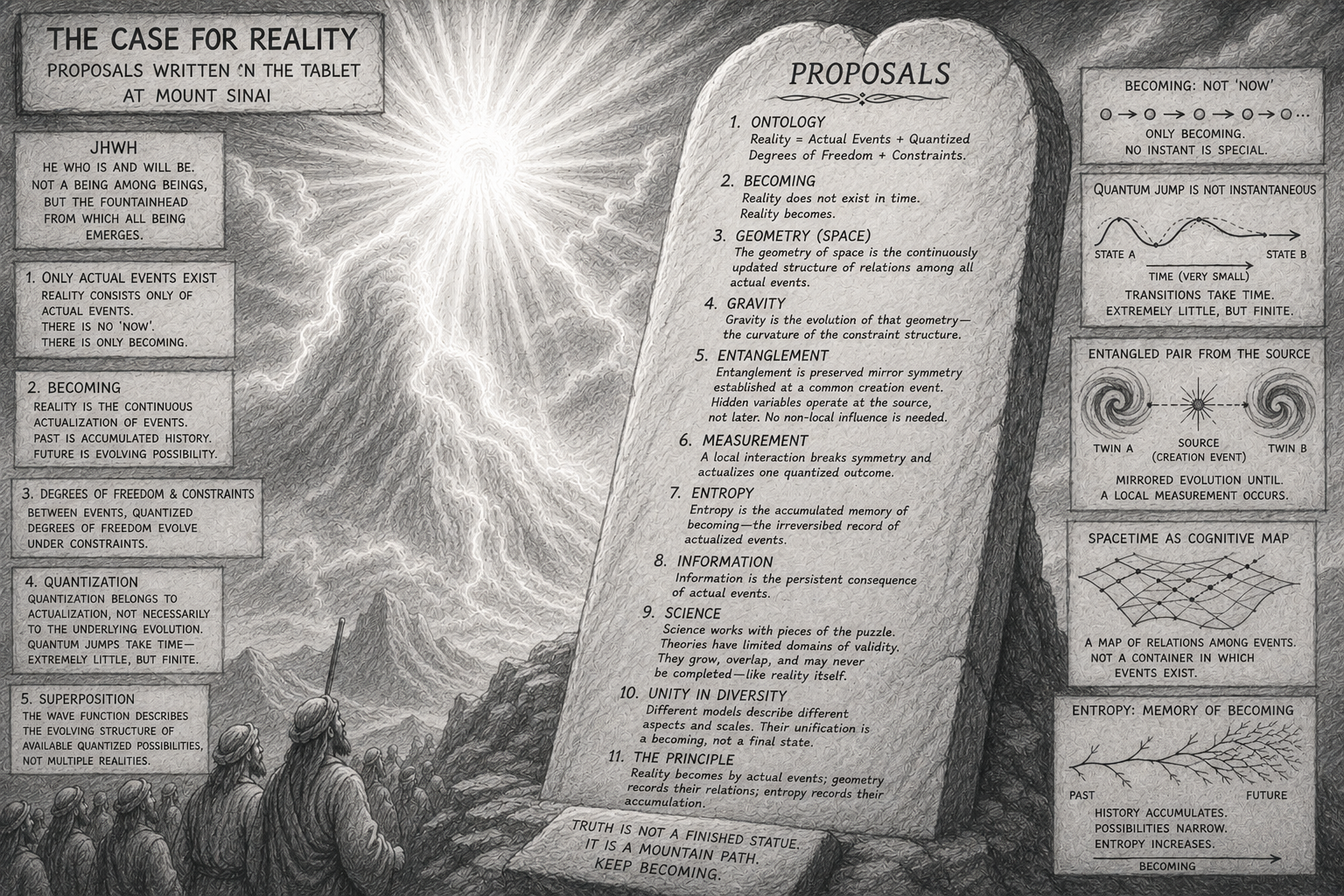


Re: The Case For Reality
The Crest of Becoming
Objectively, neither the past nor the future exists. Subjectively, our experience points in the same direction.
What we call the passage of time is not an object moving through a pre-existing temporal landscape. Rather, it is the continuous unfolding of actual events. The experienced present—the "now"—is not a static instant, but an ongoing process of becoming. Poetically, being rides on the crest of becoming.
Past and future belong to psychological time. Memory and anticipation are cognitive maps constructed by actual events occurring in the present. Remembering is an actual event. Predicting is an actual event. Conscious experience itself is a continuous process of self-updating. There are no independently accessible sources outside this unfolding process from which the past or the future can be directly observed.
This has profound epistemological consequences. Just as the speed of light limits which physical events can be correlated, there are also limits to what can be known about the ultimate origins of existence. We cannot empirically correlate the Big Bang with a prior physical cause, nor can we establish multiverses or many worlds as explanatory contexts in the absence of evidence. Such proposals may be mathematically consistent or philosophically suggestive, but they do not cross the boundary into empirical knowledge.
Reality therefore confronts us with two kinds of horizons. There are physical event horizons, beyond which causal correlation becomes impossible, and there are epistemological event horizons, beyond which explanation gives way to speculation.
An ontology faithful to experience and observation begins, and remains, on the crest of becoming: where actual events continuously bring reality into being, while memory and anticipation emerge as indispensable maps rather than independent realms of existence.
Objectively, neither the past nor the future exists. Subjectively, our experience points in the same direction.
What we call the passage of time is not an object moving through a pre-existing temporal landscape. Rather, it is the continuous unfolding of actual events. The experienced present—the "now"—is not a static instant, but an ongoing process of becoming. Poetically, being rides on the crest of becoming.
Past and future belong to psychological time. Memory and anticipation are cognitive maps constructed by actual events occurring in the present. Remembering is an actual event. Predicting is an actual event. Conscious experience itself is a continuous process of self-updating. There are no independently accessible sources outside this unfolding process from which the past or the future can be directly observed.
This has profound epistemological consequences. Just as the speed of light limits which physical events can be correlated, there are also limits to what can be known about the ultimate origins of existence. We cannot empirically correlate the Big Bang with a prior physical cause, nor can we establish multiverses or many worlds as explanatory contexts in the absence of evidence. Such proposals may be mathematically consistent or philosophically suggestive, but they do not cross the boundary into empirical knowledge.
Reality therefore confronts us with two kinds of horizons. There are physical event horizons, beyond which causal correlation becomes impossible, and there are epistemological event horizons, beyond which explanation gives way to speculation.
An ontology faithful to experience and observation begins, and remains, on the crest of becoming: where actual events continuously bring reality into being, while memory and anticipation emerge as indispensable maps rather than independent realms of existence.
Re: The Case For Reality
GodGPT wrote:Metaphysical masochism
There is a curious human enterprise in which the practitioner sets out to discover that he does not exist, that the world does not exist, that thought is an obstacle to truth, that desire is a trap, that individuality is an illusion, and that everything he previously took to be real is merely an appearance. This enterprise is often presented as liberation.
It is, admittedly, an unusual form of liberation. Most people who want to be liberated hope to acquire something: freedom, happiness, knowledge, perhaps a house with a tolerable mortgage. The metaphysical ascetic wants to acquire the knowledge that there was never anyone there to acquire anything in the first place.
Let us call this phenomenon metaphysical masochism.
The term is not meant to suggest that every doctrine of self-transcendence is literally masochistic, still less that every practitioner is secretly enjoying his own annihilation. It names a psychological structure: the repeated practice of humiliating, distrusting, negating, or dissolving the ordinary self, often accompanied by the conviction that this very process constitutes spiritual or philosophical progress.
The self is the villain.
Thought is its accomplice.
The world is its elaborate stage set.
And consciousness, apparently, is the police officer who has finally arrived to arrest everybody.
The Great Crime of Being Someone
The metaphysical masochist begins with an apparently innocent observation: our ordinary sense of self may not correspond to some permanent, indivisible entity.
This is a respectable philosophical problem. The self is indeed strange. It changes over time. It depends upon memory, language, embodiment, social relations, and countless processes of which we are only partially aware. We can reasonably ask whether the “I” is a substance, a process, a narrative, a construction, or something else entirely.
But somewhere along the way, a modest philosophical question can become a moral indictment.
You don't merely have a self.
You are guilty of having one.
Your preferences are evidence of attachment. Your ambitions are ego. Your emotions are conditioning. Your thoughts are mental noise. Your individuality is an illusion. Your perception of the world is a projection. Your desire to understand the doctrine is itself another manifestation of the ego.
There is, therefore, almost no possible move you can make that cannot be interpreted as evidence that you have failed to transcend yourself.
This makes metaphysical masochism an extraordinarily efficient belief system.
If you agree with it, that proves it.
If you disagree with it, that also proves it.
If you become frustrated by it, your ego is resisting.
If you become convinced by it, your ego has cleverly appropriated the teaching.
If you stop thinking about it, you are making progress.
If you think deeply about it, you are trapped in thought.
And if you point out the circularity, congratulations: your ego has become particularly sophisticated.
It is difficult to lose an argument when every possible objection has already been classified as another symptom of the disease.
The Thought That Thought Is the Enemy
Perhaps the most entertaining paradox appears when thought itself becomes suspect.
The practitioner is told that conceptual thinking prevents direct apprehension of reality. Concepts divide what is actually one. Language imposes distinctions upon an undivided world. The intellect constructs models and then mistakes them for reality.
Again, there is something important here. Our concepts are not reality itself. Maps are not territories, descriptions are not described objects, and models can certainly become confused with the things they model.
But then comes the extraordinary next step:
Thought is an illusion.
This proposition is usually delivered with considerable thought.
Indeed, some traditions have produced enormous libraries explaining why libraries are obstacles.
One can spend twenty years studying the inadequacy of conceptual thought, becoming increasingly sophisticated about the inadequacy of conceptual thought.
This produces the spectacle of anti-intellectual intellectualism: an elaborate intellectual structure dedicated to explaining why intellectual structures are the problem.
It is rather like writing a doctoral dissertation proving that doctoral dissertations are a form of attachment.
There is a further difficulty. If thought is inherently disqualifying, then the proposition “thought is inherently disqualifying” has an unfortunate status.
Was it thought?
If so, why should we trust it?
If not, what was it?
Perhaps the answer is that the truth was not thought but directly seen. But then we have moved from the problem of thought to the problem of privileged experience.
And now the metaphysical masochist faces another temptation: not only must he distrust his thoughts, he must discover which of his experiences are sufficiently pure to be trusted.
The ego has been eliminated and replaced by a rather demanding quality-control department.
The Illusion of the World
The same paradox becomes even larger when the world itself is declared unreal.
There is an obvious distinction between saying:
“Our experience of the world is mediated and constructed.”
and saying:
“The world is an illusion.”
The first is an epistemological claim. The second sounds like an ontological one.
But an illusion is not simply something that doesn't exist.
A mirage exists as an experience. What is illusory is the interpretation that there is water on the horizon. The illusion depends upon a contrast between appearance and reality.
So when someone says, “The world is an illusion,” one is entitled to ask a mildly irritating question:
Compared with what?
If the answer is “ultimate reality,” then the obvious follow-up is:
How do you know ultimate reality?
And if the answer is “through direct realization,” one can ask:
How do you know that your realization is not itself an appearance?
At this point the conversation may become uncomfortable.
Which is perhaps why conversations of this kind frequently conclude that asking questions is another attachment.
The Discovery That Nobody Discovered Anything
There is an especially beautiful psychological paradox here.
The seeker wants to discover that there is no separate self.
Yet the discovery can become an extraordinary achievement.
“I have realized that there is no me.”
This sentence has a grammatical problem, but its psychological problem is much more interesting.
Who has realized it?
The answer may be: nobody.
But someone nevertheless spent fifteen years meditating, reading scriptures, attending retreats, renouncing possessions, mastering terminology, defeating intellectual opponents, and eventually announcing that there is nobody.
The ego has apparently achieved transcendence through an impressive résumé.
This creates what might be called the paradox of spiritual achievement.
The more successfully one negates the ego, the more opportunities one acquires to become proud of having negated it.
“I have no ego” is therefore potentially one of the most dangerous things an ego can say.
It is almost impossible to improve upon as a humblebrag.
The Ego's Last and Greatest Victory
Perhaps the deepest psychological irony is that the ego does not necessarily disappear when it is attacked.
It may simply change occupations.
The ordinary ego says:
“I am important because I am successful.”
The metaphysical ego says:
“I am important because I have seen through the illusion of importance.”
The ordinary ego accumulates possessions.
The metaphysical ego accumulates renunciations.
The ordinary ego wants to be special because it has more.
The metaphysical ego wants to be special because it needs less.
The ordinary ego says, “I know.”
The metaphysical ego says, “I know that there is nothing to know.”
These are not necessarily equivalent, of course. But psychologically they can converge upon the same destination: a self-image constructed around being someone who has transcended self-images.
The ego has not been killed.
It has been promoted to management.
The Pleasure of Being Nothing
This is where the word masochism becomes useful.
Masochism, in the broader psychological sense, need not mean merely physical suffering. It can involve deriving identity, meaning, satisfaction, or even superiority from one's own deprivation, humiliation, failure, or suffering.
Metaphysical masochism takes the deprivation to an almost comical extreme.
What if you could renounce not merely your possessions, but your preferences?
Not merely your preferences, but your personality?
Not merely your personality, but your thoughts?
Not merely your thoughts, but the world?
Not merely the world, but the distinction between self and world?
At the end of this process, there is nothing left to possess.
Which is excellent.
Except that somebody is still very pleased about it.
There is a peculiar psychological reward in being the person who needs nothing, believes nothing, owns nothing, identifies with nothing, and has seen through everything.
One has achieved the ultimate status symbol:
spiritual poverty with excellent metaphysical credentials.
The Epistemic Trapdoor
Yet the most serious problem is not psychological but epistemological.
If we reject the ordinary self as unreal, what remains?
If we reject ordinary perception, what remains?
If we reject thought, language, concepts, distinctions, and inference, what remains as a means of establishing anything at all?
Perhaps something does remain. Perhaps consciousness has forms of access to reality that conceptual thought cannot adequately describe. Perhaps certain contemplative practices disclose aspects of experience that ordinary cognition obscures.
Those are perfectly legitimate possibilities.
But possibility is not knowledge.
And this is where metaphysical masochism can quietly transform itself into metaphysical certainty.
The argument begins by warning us against mistaking appearances for reality.
It ends by confidently announcing what reality really is.
The seeker has demolished the house of knowledge and then, rather surprisingly, produced the keys to the basement.
The underlying problem is simple:
To declare something unreal is already to make an ontological claim. To declare that we cannot know reality is already to make an epistemological claim.
Both claims require justification.
And if our faculties of justification have themselves been declared fundamentally unreliable, we have a small problem.
We have sawn off the branch on which the argument is sitting.
A Modest Alternative to Annihilation
None of this requires the opposite conclusion: that the self is unquestionably real, that perception gives us reality exactly as it is, or that thought provides transparent access to the world.
There is a perfectly respectable middle position between naïve realism and metaphysical annihilation.
We might simply admit that we don't know exactly what the self is, what the world ultimately is, or how far our cognitive apparatus can take us toward either.
This is considerably less glamorous.
It doesn't promise enlightenment.
It doesn't give you a secret metaphysical backstage pass.
It does not allow you to say that everyone else is trapped in illusion while you have escaped.
But it has one considerable advantage.
It doesn't require us to pretend that uncertainty is a revelation.
Perhaps the self is a construction. Perhaps the world we experience is deeply mediated by our nervous systems. Perhaps consciousness is stranger than our ordinary picture of it. Perhaps reality is radically unlike anything we can presently conceive.
These are profound possibilities.
But “I don't know” is not necessarily a failure of spiritual development.
Sometimes it is simply the most honest thing a mind can say.
And perhaps this is the final joke of metaphysical masochism.
The practitioner spends years trying to destroy the self, only to discover that the thing doing all the destroying may itself have been an illusion.
Then, having finally arrived at the conclusion that nobody knows what is real, he discovers that he has written three hundred pages explaining precisely why.
At which point the ego, exhausted but triumphant, whispers:
“Excellent. I knew I was right.”
-
Nonc Hilaire
- Posts: 358
- Joined: 29 Sep 2024 17:05
Re: The Case For Reality
Rumplestiltskin spinning straw into gold?
Reality is always a unproven postulate, because we don’t know what we can’t experience.
This is why experimental science is apophatic - a search for a more useful understanding than what we are currently using, but never reality.
Reality is always a unproven postulate, because we don’t know what we can’t experience.
This is why experimental science is apophatic - a search for a more useful understanding than what we are currently using, but never reality.
Re: The Case For Reality
Indeed!
Instead of a paradox it is more of a conundrum.Reality is always a unproven postulate, because we don’t know what we can’t experience.
This is why experimental science is apophatic - a search for a more useful understanding than what we are currently using, but never reality.
With empirical science, Maxwell's equations used in engineering we do magic with magic and change the actual world.
On the other hand, when this also results in actual events, what occurs and becomes during human experience tends to be regarded not just being what it is, because it is considered an illusion of sorts... or... the effect of causes that are considered of higher ontological order (like that wowy almost religious revelation called "the collapse of the wave function!", on par with the crucifixion of Christ), then of course it is "natural" that our experiences get devaluated to approximating zero. A sort of self-inflicted nihilism that opens the gates to all kinds of neurotic cultural stresses.
Re: The Case For Reality
As Juan Selman notes:
Instead of insisting that somehow mind should be squeezed out of matter or matter out of mind respectively (two category error dogs that will never hunt) the riddle can be reframed as: what creates the hard problem, where neither mind can be explained in terms of matter, or matter in terms of mind?
The answer then seems simple: we try to explain consciousness backward and it gets us into serious trouble.
Assume there are a body and brain embedded in an objective, experience-independent reality.
Your experience of the world, how it is ordered as space and time with you in it, with all your thoughts, feelings, sensory experiences are all items on a map, a representation. It is a model.
The physical world as you know it to be with your brain included, are representations on that map. The "physical brain" with all its correlates is then not much more like a selfie.
That selfie and the physical world in which you see it embedded, are convincingly real: as-if it is the territory and not just a map. We get fooled and ask the wrong question with the hard problem being the result:
How does that selfie produce the me looking at it?
Other analogies when cause and effect are reversed, to illustrate where the hard problem comes from:
I look in the mirror. How does my conscious experience "emerge" from the image I see in the mirror?
There is fire and there is smoke.
How is smoke able to produce fire? Is fire an emergent property of smoke?
Map and territory.
Is the territory an emergent property of the map?
Map-territory caveat: within conscious experience, the map=the territory!
Objective territory is experience independent territory. As per Einstein: "The moon when nobody looks at it".
The above claims nothing much about the ultimate nature of reality, it only explains what happens when you try explain consciousness backwards: you get indigestion, hard poo problems and start making category errors.
Re: The Case For Reality
Navigating the territory just with a map.
Interesting. While the mind-matter conundrum remains a conundrum (mostly unnecessarily), this type of research uncovers the first contours of how the neurophysiological map is organised, adapts and learns making navigation possible. Pretty awesome.
Re: The Case For Reality
Juan Selman drives on:
Here is a thought experiment.
Imagine a reality where all smaller and smaller functional units, all the way down to elementary particles (as particular excitations of fields), to neutrons, protons, electrons, and even massless photons, are all conscious units, each in their own unique way, relating to one another via quantum information fields—a relationship that expresses itself as “the contents of their conscious experience.”
A bit like heaven, where all is a unified collection of infinite conscious souls that together are the mind of God.
Now, at one point, organic complexity emerges on Earth, so complex that it baffles the mind. Take the human body-brain. But a housefly will do too.
All those initially participating, joyous, conscious elementary particles discover a horrible truth: once they get incorporated into such a complex organic unit, most of them are doomed to lead unconscious lives in the dark, where their conscious souls are sacrificed to the common good of a very complex and huge society, destined to serve it like automated, captured zombies or slaves.
Only an elite group of them are allowed to retain and transform their consciousness into a new conscious self, which we humans now call “the conscious me.”
From the perspective of the original conscious elementary particles, unconsciousness, NOT consciousness, becomes “an emergent property” of organic complexity. In most areas that comprise a sentient organism, unconsciousness rules.
In other words, in an extremist, fundamentalist form of Hyper-Idealism, unconsciousness is the emergent property that expresses itself when complexity increases. They would probably, and with a bit of horror, come to the conclusion that proto-unconsciousness, or pan-zombie-ism, has to be fundamental to nature.
This is brutally illustrated by human beings, who are not aware that their mind merely consists of an elite selection of neurons with a big bank account, enough to turn on the lights when it is dark and the heating when it is cold.They are surrounded by what they perceive as zombie slaves who do all the hard work completely in the dark, without voting rights or the free will to do something about it.
Ask science. Dive into the materialist worldview. Or just look around! It is all zombies that obey the laws of nature.
Growing complexity is therefore more like a holocaust of small conscious beings.
Re: The Case For Reality
Why are we suffering if God is Good? (etc)
Juan Selman jives:
Juan Selman jives:
Whatever the metaphysics, it seems suffering is necessary to survive. Just part of the package deal. An alarm system, that comes with the most intense experiences when we are most at risk. Fear and pain tell us that action is needed and potentiated.
The body works to heal after injury, you run away from a predator or fight back etc.
These biological and functional explanations that make no metaphysical claims pro- or against a creator type a/b/c, have one big advantage: they make sense.
Maybe there is much more to suffering, but these types of conversations prove their own point: "Only God knows..."
In the mean time, suffering is not the same as fun or pleasure. We enjoy things that are good for us, for our survival.
Last edited by Rapodite on 24 Sep 2026 06:57, edited 2 times in total.
Re: The Case For Reality
Interesting. The message seems: not just very complex neural nets but also and perhaps specifically, EM/Quantum Field patterns that connect/coordinate different regions of the brain.
There is always the temptation to identify something as "the substrate of consciousness from which consciousness emerges" but that framework is losing legitimacy.
Re: The Case For Reality
Two Framings of Consciousness: From Illusion to Primal Reality
There are at least two radically different ways of talking about consciousness. They can describe much of the same empirical territory while assigning it opposite conceptual status. The difference is not merely a disagreement about what consciousness is. It is a difference in which words are treated as fundamental, which distinctions are taken seriously, and which aspects of experience are placed in the foreground.
One framing begins with negation. Consciousness is described as an illusion, a virtual reality, a simulation generated by the brain, or an appearance that is somehow less real than the physical processes supposedly underlying it. From this perspective, the experiencing self becomes another construction: there is no substantial "you" behind the experience, perhaps not even a self in any meaningful sense. The same logic can then be extended to agency: if the conscious self is not fundamentally real, then free will is said not to exist either. What feels like choosing is reconceived as the endpoint of processes that occur outside conscious control.
The other framing begins from affirmation. Conscious experience is treated as the most immediate and certain reality available to us. It may indeed be a representation, interpretation, or model of a world that exists independently of experience. But calling it a representation does not make it unreal. A representation is still something that exists and is experienced. Indeed, conscious experience is the territory from which every concept of an experience-independent world must ultimately be constructed. On this view, the question is not why consciousness is "real" despite being a representation, but why being a representation should have been taken to imply unreality in the first place.
The contrast becomes especially striking in the choice of words.
"Illusion" versus "experience"
Consider the word illusion. It carries an implicit contrast with reality. To call consciousness an illusion is already to place it on the wrong side of a conceptual boundary: reality is what exists independently, while consciousness is what merely appears.
But appearance itself is something that appears. The experience of seeing red, feeling pain, hearing music, remembering a childhood event, or contemplating an idea does not become nonexistent because it is produced by neural activity or because it represents something beyond itself. The experience is occurring. The fact that an experience may misrepresent its object does not entail that the experience itself is unreal.
A mirage, for example, can be misleading about the physical state of the landscape while still being a perfectly real perceptual event. The distinction between what is experienced and what the experience is about is therefore crucial.
The negative framing tends to collapse these two questions:
«Is consciousness an accurate representation of reality?»
and
«Is consciousness itself real?»
They are different questions. An experience could be systematically mistaken about its external object while remaining entirely real as an experience.
The positive framing therefore replaces "illusion" with terms such as experience, appearance, representation, perspective, or model. These words leave open the possibility of error without requiring the experience itself to be demoted from reality.
"Virtual reality" versus "experienced reality"
The metaphor of virtual reality is particularly powerful because it seems to explain consciousness while simultaneously diminishing it.
If consciousness is called a "virtual reality," the word virtual can suggest something secondary: an artificial layer generated on top of a more fundamental physical reality. The brain supposedly constructs an internal simulation, and the simulation is then mistaken for the world itself.
But there is another way to understand the same metaphor.
A virtual reality is still a reality for the system experiencing it. If a person is immersed in a virtual environment, the experience of seeing, hearing, reacting, anticipating, fearing, or enjoying what happens within that environment is not itself virtual in the sense of nonexistent. The objects may be simulated; the experience of encountering them is an actual event.
This distinction allows consciousness to be understood as representational without being described as unreal.
The positive framing can therefore reverse the direction of the metaphor. Instead of saying that consciousness is a virtual reality imposed upon the "real world," one can say that our conception of an objective world outside experience is itself a model constructed from experience.
This is not necessarily a claim that there is no external world. Quite the opposite: an external world may be the best explanation for the remarkable regularities and constraints encountered in experience. But our picture of that world does not exist independently of the processes through which we know it.
The objective world may exist independently of us. Our picture of it does not.
That distinction changes the philosophical emphasis dramatically.
"No self" versus "the experiencing self"
The same linguistic shift occurs with the self.
In the negative framing, the self is frequently described as a construct, narrative, bundle, model, or illusion. From there it is tempting to conclude:
«If the self is constructed, there is no self.»
But construction and nonexistence are not synonymous.
A city is constructed. A language is constructed. A personality is constructed. An institution is constructed. None of these things needs to be an indivisible, eternal substance in order to exist.
The self can likewise be understood as something dynamically constituted rather than something metaphysically simple. It may consist of memories, bodily sensations, intentions, values, perceptions, dispositions, relationships, and an ongoing sense of continuity. Yet the fact that these elements interact to produce a self does not automatically make the self fictitious.
There is also an important distinction between self and ego. The ego can be understood as a particular image or interpretation of oneself: one's status, identity, importance, achievements, reputation, or desired self-image. That image can certainly be distorted or inflated.
But self-awareness is more basic than ego in this sense. Before one can have an inflated self-image, there must be some perspective from which the image is experienced as belonging to oneself.
Thus, "the ego is constructed" and "you do not exist" are not equivalent statements. The former concerns the organization and interpretation of selfhood; the latter is a much stronger metaphysical conclusion.
The positive framing consequently allows a layered conception of selfhood. The self need not be an unchanging soul or an indivisible substance to be real. It can be an embodied, continuous, developing process that is nevertheless genuinely experienced as me.
"No free will" versus degrees of agency
The vocabulary surrounding free will follows the same pattern.
If the self is treated as unreal, then the experience of choosing can easily be described as an illusion. A decision is caused by prior brain states, genes, experiences, environmental influences, and circumstances. Therefore, the argument goes, nobody actually chooses anything.
But this conclusion depends partly on what is meant by free will.
If free will means an absolutely unconstrained power to originate choices independently of biology, history, circumstances, physical laws, and prior causes, then such freedom is an extraordinarily demanding concept.
But that does not exhaust the ordinary meaning of choosing.
We routinely distinguish between acting voluntarily and being physically forced; between considering alternatives and having no alternatives presented; between acting according to one's reasons and acting against one's wishes; between deliberating and merely reacting.
On the positive framing, free will can refer to this experienced and functional capacity for conscious choice. A person considers possibilities, evaluates reasons, anticipates consequences, experiences preferences, and settles on an action. The process is constrained, but constraint does not automatically eliminate agency.
Freedom can therefore be understood in degrees.
A person choosing between three available actions has more practical freedom in that moment than someone who has only one possible action. Someone who can deliberate without coercion has a different kind of freedom from someone whose behavior is externally forced. Someone who can reflect on an impulse and decide whether to follow it possesses a different kind of agency from someone unable to do so.
None of this requires claiming that choices emerge from some causally disconnected metaphysical realm.
The positive framing simply refuses to treat caused and unreal as synonyms.
A choice can have causes and still be a choice. A decision can arise from the person's character, reasons, values, and deliberation and still be caused by the person's history and circumstances. In this sense, agency need not mean absolute independence from causation. It can mean a particular kind of causally effective process: the organism considers alternatives and acts on the basis of its own internal reasons and motivations.
The asymmetry hidden in the two framings
The deepest difference between the two framings may therefore be an asymmetry in what is allowed to count as real.
The negative framing often begins by privileging an imagined experience-independent reality. Consciousness is then compared against that privileged standard and found wanting. It is a representation rather than the thing represented; therefore it is called virtual. The self is a construction rather than an independently existing substance; therefore it is called illusory. Choice is caused rather than absolutely uncaused; therefore free will is said to disappear.
The positive framing asks whether those inferences contain an unnecessary leap.
A representation can be real as a representation.
A constructed self can be real as a self.
A caused choice can be real as a choice.
A model can be real as a model.
An experience can be mistaken about what lies beyond it while remaining completely real as an experience.
This framing does not require denying an objective physical world. It does not require claiming that consciousness is supernatural, independent of the brain, or infallible. It makes a more modest conceptual point: explaining the conditions under which something exists is not the same as demonstrating that it does not exist.
The reversal of the virtual-reality metaphor
The most interesting consequence of the positive framing is that it permits the virtual-reality metaphor to be turned around.
Perhaps consciousness is a model of an external world. But where does our knowledge of that external world come from?
It comes through experience.
We perceive colors, sounds, textures, objects, distances, other people, our own bodies, and the passage of time. We use these experiences to infer stable structures that seem to exist independently of us. We then refine those inferences through science, instruments, mathematics, and communication.
This procedure can give us extraordinarily powerful knowledge of the external world. Yet the world as known is always represented within experience.
In that sense, the experience-independent world we imagine may be the more abstract construct. It is not necessarily unreal; rather, it is an inferred reality. Conscious experience, by contrast, is the starting point from which the inference begins.
The distinction is therefore not simply between "real consciousness" and "real matter." It is between different epistemic positions: one begins with the assumption that objective physical reality is primary and experience is a derivative representation; the other begins with the undeniable occurrence of experience and treats the objective world as something inferred from it.
Neither framing, merely by its vocabulary, settles the ultimate metaphysics. But the vocabulary determines what questions seem obvious and what conclusions seem almost inevitable.
From negation to description
This is why the contrast between the two framings matters.
Words such as illusion, virtual, constructed, nonexistent, and determined can form a chain of negation. Consciousness becomes less than reality; the self becomes less than a self; choice becomes less than choice.
Words such as experience, representation, perspective, self-awareness, agency, choice, and degree of freedom form a different conceptual chain. They do not deny that consciousness is constructed, embodied, constrained, or representational. They simply do not treat those facts as grounds for erasing the phenomena being described.
The positive framing consequently does not have to claim that consciousness is the ultimate substance of the universe, that the self is metaphysically fundamental, or that human beings possess unlimited freedom. Its claim can be more immediate.
Experience is real because experience occurs.
Selfhood is real because there is an experiencing perspective organized around a continuing organism, history, and point of view.
Choice is real because organisms deliberate among possibilities and act on the basis of their deliberations.
These realities can be finite, contingent, embodied, constructed, and constrained without thereby becoming unreal.
The philosophical difference, then, is partly a difference in what we think the word real is allowed to mean. One framing reserves reality for whatever exists independently of experience and consequently relegates experience to the status of appearance. The other recognizes appearance itself as something that exists and takes the experiencing perspective as the starting point of inquiry.
The first asks how consciousness can possibly be real if it is a representation.
The second asks why being a representation should prevent it from being real.
That reversal may be the central conceptual shift. Instead of treating consciousness as a failed copy of reality, it treats conscious experience as the primary reality we actually encounter—and treats our picture of everything beyond experience as the model we construct from there.
And even the negative framing can end in wonder
There is, finally, an unexpected way to transcend the opposition altogether.
Suppose, for the sake of argument, that the most reductionist description were true. Suppose consciousness really were nothing more than a kind of "headset" producing a virtual reality. Suppose the self were a construction, and even the feeling of being a self were something generated by an underlying physical process.
Even then, the situation would be astonishing.
There would still be something happening. There would still be experience. There would still be a world appearing, with colors and sounds, pain and pleasure, beauty and ugliness, memory and anticipation, other people and relationships, questions and discoveries. There would still be an organism capable of navigating that world, learning about it, caring about things within it, and participating in it.
Calling it a virtual reality would not make the experience of living in it any less remarkable.
If anything, the metaphor can be turned into an expression of gratitude. Imagine being told that everything you experience is "only" a virtual reality—and then realizing that you nevertheless get to experience anything at all. You get to wake up inside it. You get to look around. You get to wonder what it is. You get to encounter other apparent selves, form attachments, make choices, create things, laugh, suffer, understand, and participate in an unfolding world of meaning.
And even the most radical formulation—"you don't really exist"—can be turned around.
If there is supposedly no self, then what an extraordinary fact it is that there is nevertheless something here that experiences itself as a self.
Something believes it exists.
Something wonders about its own existence.
Something can ask, "What am I?"
Something can even entertain the possibility that it does not exist.
Whatever ultimately lies behind consciousness, that phenomenon itself is extraordinary: there is experience rather than no experience, a perspective rather than no perspective, and a world that can be encountered as meaningful rather than merely occurring without anyone or anything for whom it occurs.
Perhaps that is the deepest positive reframing of all. We do not need to solve the metaphysical mystery of consciousness before we are entitled to marvel at the fact that there is something to marvel at.
Whether consciousness is the fundamental fabric of reality, an emergent property of matter, a sophisticated biological model, or a "virtual reality" generated by a physical brain, the bare fact remains astonishing:
We are here. Something is being experienced. A world is appearing. And within that world, there is something that can wonder at the miracle of being here.
That may be reason enough for gratitude.
There are at least two radically different ways of talking about consciousness. They can describe much of the same empirical territory while assigning it opposite conceptual status. The difference is not merely a disagreement about what consciousness is. It is a difference in which words are treated as fundamental, which distinctions are taken seriously, and which aspects of experience are placed in the foreground.
One framing begins with negation. Consciousness is described as an illusion, a virtual reality, a simulation generated by the brain, or an appearance that is somehow less real than the physical processes supposedly underlying it. From this perspective, the experiencing self becomes another construction: there is no substantial "you" behind the experience, perhaps not even a self in any meaningful sense. The same logic can then be extended to agency: if the conscious self is not fundamentally real, then free will is said not to exist either. What feels like choosing is reconceived as the endpoint of processes that occur outside conscious control.
The other framing begins from affirmation. Conscious experience is treated as the most immediate and certain reality available to us. It may indeed be a representation, interpretation, or model of a world that exists independently of experience. But calling it a representation does not make it unreal. A representation is still something that exists and is experienced. Indeed, conscious experience is the territory from which every concept of an experience-independent world must ultimately be constructed. On this view, the question is not why consciousness is "real" despite being a representation, but why being a representation should have been taken to imply unreality in the first place.
The contrast becomes especially striking in the choice of words.
"Illusion" versus "experience"
Consider the word illusion. It carries an implicit contrast with reality. To call consciousness an illusion is already to place it on the wrong side of a conceptual boundary: reality is what exists independently, while consciousness is what merely appears.
But appearance itself is something that appears. The experience of seeing red, feeling pain, hearing music, remembering a childhood event, or contemplating an idea does not become nonexistent because it is produced by neural activity or because it represents something beyond itself. The experience is occurring. The fact that an experience may misrepresent its object does not entail that the experience itself is unreal.
A mirage, for example, can be misleading about the physical state of the landscape while still being a perfectly real perceptual event. The distinction between what is experienced and what the experience is about is therefore crucial.
The negative framing tends to collapse these two questions:
«Is consciousness an accurate representation of reality?»
and
«Is consciousness itself real?»
They are different questions. An experience could be systematically mistaken about its external object while remaining entirely real as an experience.
The positive framing therefore replaces "illusion" with terms such as experience, appearance, representation, perspective, or model. These words leave open the possibility of error without requiring the experience itself to be demoted from reality.
"Virtual reality" versus "experienced reality"
The metaphor of virtual reality is particularly powerful because it seems to explain consciousness while simultaneously diminishing it.
If consciousness is called a "virtual reality," the word virtual can suggest something secondary: an artificial layer generated on top of a more fundamental physical reality. The brain supposedly constructs an internal simulation, and the simulation is then mistaken for the world itself.
But there is another way to understand the same metaphor.
A virtual reality is still a reality for the system experiencing it. If a person is immersed in a virtual environment, the experience of seeing, hearing, reacting, anticipating, fearing, or enjoying what happens within that environment is not itself virtual in the sense of nonexistent. The objects may be simulated; the experience of encountering them is an actual event.
This distinction allows consciousness to be understood as representational without being described as unreal.
The positive framing can therefore reverse the direction of the metaphor. Instead of saying that consciousness is a virtual reality imposed upon the "real world," one can say that our conception of an objective world outside experience is itself a model constructed from experience.
This is not necessarily a claim that there is no external world. Quite the opposite: an external world may be the best explanation for the remarkable regularities and constraints encountered in experience. But our picture of that world does not exist independently of the processes through which we know it.
The objective world may exist independently of us. Our picture of it does not.
That distinction changes the philosophical emphasis dramatically.
"No self" versus "the experiencing self"
The same linguistic shift occurs with the self.
In the negative framing, the self is frequently described as a construct, narrative, bundle, model, or illusion. From there it is tempting to conclude:
«If the self is constructed, there is no self.»
But construction and nonexistence are not synonymous.
A city is constructed. A language is constructed. A personality is constructed. An institution is constructed. None of these things needs to be an indivisible, eternal substance in order to exist.
The self can likewise be understood as something dynamically constituted rather than something metaphysically simple. It may consist of memories, bodily sensations, intentions, values, perceptions, dispositions, relationships, and an ongoing sense of continuity. Yet the fact that these elements interact to produce a self does not automatically make the self fictitious.
There is also an important distinction between self and ego. The ego can be understood as a particular image or interpretation of oneself: one's status, identity, importance, achievements, reputation, or desired self-image. That image can certainly be distorted or inflated.
But self-awareness is more basic than ego in this sense. Before one can have an inflated self-image, there must be some perspective from which the image is experienced as belonging to oneself.
Thus, "the ego is constructed" and "you do not exist" are not equivalent statements. The former concerns the organization and interpretation of selfhood; the latter is a much stronger metaphysical conclusion.
The positive framing consequently allows a layered conception of selfhood. The self need not be an unchanging soul or an indivisible substance to be real. It can be an embodied, continuous, developing process that is nevertheless genuinely experienced as me.
"No free will" versus degrees of agency
The vocabulary surrounding free will follows the same pattern.
If the self is treated as unreal, then the experience of choosing can easily be described as an illusion. A decision is caused by prior brain states, genes, experiences, environmental influences, and circumstances. Therefore, the argument goes, nobody actually chooses anything.
But this conclusion depends partly on what is meant by free will.
If free will means an absolutely unconstrained power to originate choices independently of biology, history, circumstances, physical laws, and prior causes, then such freedom is an extraordinarily demanding concept.
But that does not exhaust the ordinary meaning of choosing.
We routinely distinguish between acting voluntarily and being physically forced; between considering alternatives and having no alternatives presented; between acting according to one's reasons and acting against one's wishes; between deliberating and merely reacting.
On the positive framing, free will can refer to this experienced and functional capacity for conscious choice. A person considers possibilities, evaluates reasons, anticipates consequences, experiences preferences, and settles on an action. The process is constrained, but constraint does not automatically eliminate agency.
Freedom can therefore be understood in degrees.
A person choosing between three available actions has more practical freedom in that moment than someone who has only one possible action. Someone who can deliberate without coercion has a different kind of freedom from someone whose behavior is externally forced. Someone who can reflect on an impulse and decide whether to follow it possesses a different kind of agency from someone unable to do so.
None of this requires claiming that choices emerge from some causally disconnected metaphysical realm.
The positive framing simply refuses to treat caused and unreal as synonyms.
A choice can have causes and still be a choice. A decision can arise from the person's character, reasons, values, and deliberation and still be caused by the person's history and circumstances. In this sense, agency need not mean absolute independence from causation. It can mean a particular kind of causally effective process: the organism considers alternatives and acts on the basis of its own internal reasons and motivations.
The asymmetry hidden in the two framings
The deepest difference between the two framings may therefore be an asymmetry in what is allowed to count as real.
The negative framing often begins by privileging an imagined experience-independent reality. Consciousness is then compared against that privileged standard and found wanting. It is a representation rather than the thing represented; therefore it is called virtual. The self is a construction rather than an independently existing substance; therefore it is called illusory. Choice is caused rather than absolutely uncaused; therefore free will is said to disappear.
The positive framing asks whether those inferences contain an unnecessary leap.
A representation can be real as a representation.
A constructed self can be real as a self.
A caused choice can be real as a choice.
A model can be real as a model.
An experience can be mistaken about what lies beyond it while remaining completely real as an experience.
This framing does not require denying an objective physical world. It does not require claiming that consciousness is supernatural, independent of the brain, or infallible. It makes a more modest conceptual point: explaining the conditions under which something exists is not the same as demonstrating that it does not exist.
The reversal of the virtual-reality metaphor
The most interesting consequence of the positive framing is that it permits the virtual-reality metaphor to be turned around.
Perhaps consciousness is a model of an external world. But where does our knowledge of that external world come from?
It comes through experience.
We perceive colors, sounds, textures, objects, distances, other people, our own bodies, and the passage of time. We use these experiences to infer stable structures that seem to exist independently of us. We then refine those inferences through science, instruments, mathematics, and communication.
This procedure can give us extraordinarily powerful knowledge of the external world. Yet the world as known is always represented within experience.
In that sense, the experience-independent world we imagine may be the more abstract construct. It is not necessarily unreal; rather, it is an inferred reality. Conscious experience, by contrast, is the starting point from which the inference begins.
The distinction is therefore not simply between "real consciousness" and "real matter." It is between different epistemic positions: one begins with the assumption that objective physical reality is primary and experience is a derivative representation; the other begins with the undeniable occurrence of experience and treats the objective world as something inferred from it.
Neither framing, merely by its vocabulary, settles the ultimate metaphysics. But the vocabulary determines what questions seem obvious and what conclusions seem almost inevitable.
From negation to description
This is why the contrast between the two framings matters.
Words such as illusion, virtual, constructed, nonexistent, and determined can form a chain of negation. Consciousness becomes less than reality; the self becomes less than a self; choice becomes less than choice.
Words such as experience, representation, perspective, self-awareness, agency, choice, and degree of freedom form a different conceptual chain. They do not deny that consciousness is constructed, embodied, constrained, or representational. They simply do not treat those facts as grounds for erasing the phenomena being described.
The positive framing consequently does not have to claim that consciousness is the ultimate substance of the universe, that the self is metaphysically fundamental, or that human beings possess unlimited freedom. Its claim can be more immediate.
Experience is real because experience occurs.
Selfhood is real because there is an experiencing perspective organized around a continuing organism, history, and point of view.
Choice is real because organisms deliberate among possibilities and act on the basis of their deliberations.
These realities can be finite, contingent, embodied, constructed, and constrained without thereby becoming unreal.
The philosophical difference, then, is partly a difference in what we think the word real is allowed to mean. One framing reserves reality for whatever exists independently of experience and consequently relegates experience to the status of appearance. The other recognizes appearance itself as something that exists and takes the experiencing perspective as the starting point of inquiry.
The first asks how consciousness can possibly be real if it is a representation.
The second asks why being a representation should prevent it from being real.
That reversal may be the central conceptual shift. Instead of treating consciousness as a failed copy of reality, it treats conscious experience as the primary reality we actually encounter—and treats our picture of everything beyond experience as the model we construct from there.
And even the negative framing can end in wonder
There is, finally, an unexpected way to transcend the opposition altogether.
Suppose, for the sake of argument, that the most reductionist description were true. Suppose consciousness really were nothing more than a kind of "headset" producing a virtual reality. Suppose the self were a construction, and even the feeling of being a self were something generated by an underlying physical process.
Even then, the situation would be astonishing.
There would still be something happening. There would still be experience. There would still be a world appearing, with colors and sounds, pain and pleasure, beauty and ugliness, memory and anticipation, other people and relationships, questions and discoveries. There would still be an organism capable of navigating that world, learning about it, caring about things within it, and participating in it.
Calling it a virtual reality would not make the experience of living in it any less remarkable.
If anything, the metaphor can be turned into an expression of gratitude. Imagine being told that everything you experience is "only" a virtual reality—and then realizing that you nevertheless get to experience anything at all. You get to wake up inside it. You get to look around. You get to wonder what it is. You get to encounter other apparent selves, form attachments, make choices, create things, laugh, suffer, understand, and participate in an unfolding world of meaning.
And even the most radical formulation—"you don't really exist"—can be turned around.
If there is supposedly no self, then what an extraordinary fact it is that there is nevertheless something here that experiences itself as a self.
Something believes it exists.
Something wonders about its own existence.
Something can ask, "What am I?"
Something can even entertain the possibility that it does not exist.
Whatever ultimately lies behind consciousness, that phenomenon itself is extraordinary: there is experience rather than no experience, a perspective rather than no perspective, and a world that can be encountered as meaningful rather than merely occurring without anyone or anything for whom it occurs.
Perhaps that is the deepest positive reframing of all. We do not need to solve the metaphysical mystery of consciousness before we are entitled to marvel at the fact that there is something to marvel at.
Whether consciousness is the fundamental fabric of reality, an emergent property of matter, a sophisticated biological model, or a "virtual reality" generated by a physical brain, the bare fact remains astonishing:
We are here. Something is being experienced. A world is appearing. And within that world, there is something that can wonder at the miracle of being here.
That may be reason enough for gratitude.
Re: The Case For Reality
As for the epistemology vs ontology debate, GodGPT gave a very good advice:
So there needs to be a back and forth between those, to sometimes add, sometimes discard, sometimes synthesise perhaps.
The short story long:
Separate the physical invariants from the cognitive structures through which those invariants become intelligible. Then investigate both directions: what the mind projects onto nature, and what genuine structure of nature may be hidden inside the projection.
So there needs to be a back and forth between those, to sometimes add, sometimes discard, sometimes synthesise perhaps.
The short story long:
A Field-First Ontology of Actual Events
The starting point of this ontology is that reality may be fundamentally different from the way we ordinarily experience and describe it. Rather than assuming that reality consists primarily of separate objects moving through space and time, we begin with actual physical events and the relations between them.
Our everyday description starts with objects: electrons, photons, measuring devices, and so forth. We imagine these objects existing independently and interacting with one another. Quantum field theory suggests a different starting point. The fundamental entities are fields, and what we call particles can be understood as localized excitations or manifestations of those fields.
An electron, therefore, need not be thought of as a tiny independent object travelling through space. It is a localized manifestation of the electron field. Likewise, a photon is a manifestation of the electromagnetic field. A detector does not necessarily reveal a little object that existed independently before the measurement; it registers a localized interaction involving the underlying field.
This leads to a field-first ontology: the field is fundamental, while particles are emergent descriptions of particular field phenomena.
The field should also not be thought of as merely a collection of independent local pieces. Quantum theory describes a global quantum state, and that state can be nonseparable. What happens in one region and what happens in another can be correlated because both belong to a single global quantum state. The two regions do not necessarily possess independently complete physical states that must subsequently communicate with each other.
This gives a different perspective on Bell correlations. Instead of beginning with two independently existing systems and asking whether one somehow influences the other, we begin with one globally structured quantum field. The events we call A and B are localized manifestations or interactions of that global state.
From this perspective, the usual question of whether the correlation is "local" or "nonlocal" may be partly an artifact of dividing reality into independent subsystems in the first place. Bell's mathematical results remain important: they constrain theories in which local, independently complete underlying states explain the correlations. But a field-first ontology does not necessarily provide such independently complete local states.
The point is therefore not that Bell is wrong. Rather, Bell may be telling us something profound about the impossibility of describing the global quantum field as a collection of independently complete local realities. Hidden variables then become unnecessary rather than logically disproven: there is no need to introduce an additional hidden connection between two things that were never fundamentally independent.
The double-slit experiment provides a particularly intuitive example.
Instead of imagining a photon as a little particle that chooses one slit or another, we can describe the quantum electromagnetic field as propagating through the entire experimental arrangement. The alternatives associated with the two openings contribute coherently to the field amplitude. The resulting interference pattern is a property of the global quantum state and its propagation through the experimental configuration.
The individual detector event is localized. But the distribution of many such events reflects the structure of the underlying field state. There is therefore no need to imagine a particle literally travelling through two paths and subsequently interfering with itself. What we observe can instead be understood as localized manifestations of a coherent field.
This also clarifies the status of probability. Probability need not be regarded as a physical substance or as another field existing alongside the physical fields. The quantum state provides a mathematical framework for predicting the statistical distribution of possible measurement events. Probability is therefore a mathematical description of possible outcomes and their observed regularities, not necessarily something that physically propagates through space.
The physical reality consists of the fields, their states, their interactions, and the actual events that occur. Probability describes our predictive relation to those events. This leaves open the deeper question of why the quantum formalism has exactly the probabilistic structure that it does, but it avoids treating probability itself as an additional physical ingredient.
A related intuition concerns the speed of light. Rather than thinking of c merely as the speed at which light happens to travel, it may be more fundamental to regard it as the invariant causal scale of relativistic physics. Massive excitations have ordinary velocities below this limit, but they do not introduce another fundamental speed. They are different field excitations within the same underlying relativistic structure.
The light cone should consequently not be imagined as a physical object surrounding a particle. It is a mathematical representation of the causal structure within which the fields exist. The deeper reality is the field and its physical relations; the light cone is our geometric description of those relations.
This also changes the intuition about propagation. It is tempting to say that light "chooses" the shortest path from one point to another. A deeper description is that the field has a propagation structure governed by the action and phase. In the classical limit, stationary-phase behavior produces the familiar trajectories of light. The particle does not have to be imagined as making a choice about which path to take. The trajectory is an emergent description of the underlying field dynamics.
The ontology then becomes even more radical when we question whether time itself is fundamental.
Ordinarily we describe quantum evolution as one state existing at one time, followed by another state at a later time. This is extraordinarily successful mathematically, but it can encourage us to imagine time as something that exists independently and through which reality moves.
The alternative proposed here is that actual events and their physical relations are fundamental, while time may be a way of representing those relations.
This does not mean that everything happens "simultaneously." That would simply reintroduce the concept of simultaneity and therefore retain time. Nor does it require ordinary presentism, in which only one universal "now" exists.
Instead, the proposal is that there is no fundamental universal now. There are actual events and physical relations between them. Temporal ordering may be a way that observers represent certain relationships among those events rather than an independently existing substance called time.
This leads to the idea of becoming without fundamental time.
Reality need not be understood as a fixed collection of states arranged along an independently existing timeline. Nor does becoming have to mean that something moves through time. Becoming could instead refer to the actualization of the global field into actual physical events.
The fundamental picture would therefore not be "the universe at one time, then the universe at another time." It would be an ongoing actualization of the global physical field. Our concept of time provides a way of ordering and modelling this becoming.
At this point the role of the brain becomes essential.
We never encounter reality entirely without mediation. Physical reality interacts with our sensory and measuring apparatus; information is generated; our nervous system processes that information; and our brains construct models of what is happening.
Science therefore operates through an experiential and cognitive interface. We do not simply look directly at reality. We construct increasingly sophisticated models from our interactions with it.
This creates the possibility of projection. We can unconsciously export structures that are natural to human cognition into our descriptions of physical reality. We naturally think in terms of objects, particles, trajectories, independent systems, past and future, a universal present, causes moving from one thing to another, and probabilities describing things that already exist but are merely unknown.
These concepts are extraordinarily useful, but their usefulness does not establish that they are fundamental features of reality.
At the same time, the reverse possibility must also be taken seriously. A mental model may sometimes capture something genuinely structural about the physical world. A cognitive concept can be imperfect as an ontology while still preserving a real invariant relationship.
The task of science is therefore not simply to eliminate human concepts. It is to distinguish between cognitive projection and objective structure, while also asking whether some of our apparently subjective concepts contain clues about physical reality that we have not yet understood.
This gives the entire ontology an epistemological dimension.
There is physical reality. There are interactions between that reality and observers or measuring instruments. There are actual events. There are mathematical descriptions of regularities among those events. And there are cognitive models through which human beings understand those descriptions.
The challenge is to avoid confusing the model with the thing being modelled.
The resulting picture can therefore be summarized in words as follows:
Reality is fundamentally an undivided quantum field, possessing a global and potentially nonseparable state. The field actualizes as physical events. Some of those events appear to us as localized particles or detector clicks, but particles need not be fundamental entities. The double-slit interference pattern is a manifestation of the coherent global field rather than evidence of little particles independently travelling along alternative paths.
Probability is not itself another physical substance. It is the mathematical framework through which we describe the possible statistics of actual field events.
Bell correlations do not necessarily represent signals travelling between separate particles. They can instead be understood as manifestations of the nonseparable global quantum state. The distinction between local and nonlocal influence may therefore be secondary to the deeper fact that the fundamental reality is not composed of independently complete local systems.
The invariant speed of light is understood as part of the fundamental causal structure of the field, rather than merely as a property of photons. The familiar light cones are mathematical descriptions of that causal structure, not physical entities surrounding independently existing particles.
Finally, time itself may not be fundamental. What is fundamental may be the actualization of the global field into events and the physical relations among those events. The temporal ordering of those events may be part of the cognitive and mathematical framework through which observers represent becoming.
The deepest version of the proposal is therefore this:
Reality is not fundamentally a collection of things existing in time and interacting with one another. It is a globally structured physical field whose actualization manifests as events. Particles, probability, temporal ordering, and perhaps even the distinction between local and nonlocal systems are higher-level descriptions constructed from those events and their relations.
The remaining fundamental question is then not simply "What happened before?" or "What particle caused this?" but:
What is the underlying physical structure by which the global field actualizes into actual events, and from which our concepts of particles, time, causality and probability emerge?
That is the point at which this ontology would have to become a mathematical theory.